
Explore the Encyclopedia of Acting and Voice: one alphabetical reference for acting, voice, movement, imagination, awareness and rehearsal. Use the contents to jump to an entry, follow its sources, and connect the ideas with practice.
Using the encyclopedia
Connect the terms with your practice
Acting involves attention, emotion, memory, imagination, voice, movement and relationship. The entries bring the vocabulary of those processes together with rehearsal practices and theatrical traditions in one alphabetical reference.
Read each term in its named tradition and follow the sources. A research construct, a clinical model, an artistic practice and a spiritual interpretation make different kinds of claims. Connections can be useful without making the traditions interchangeable.
At JBAS, freeing the human instrument, cultivating awareness and cultivating the Aware Ego Process form a connected practice. Archetype Work brings voice, sound, movement and imagination into an embodied investigation. The rehearsal suggestions that follow are practical applications for actors.
Explore the Encyclopedia of Acting and Voice, Hal and Sidra Stone’s article library, and Caroline Myss’s archetype gallery.
Accentuation
Accentuation is the emphasis that lets you give different words different weight. You can bring a word forward through pitch, duration, a pause or a change in vocal color. Greater volume is one choice among several. In a scene, the useful question is which word carries your thought and what you need the other person to understand through it.
In rehearsal
Take the line “You promised to come back.” Speak it to your partner with the emphasis on “you,” then “promised,” then “back.” Let each choice change what you are asking your partner to face. Keep the rest of the sentence available, and notice which version serves the circumstances instead of choosing the most musical pattern.
Sources
The Encyclopedia of Acting, historical studio compilation credited to Jason Bennett and others, “Accentuation.”
Related entries
Subtext · Action · Specificity
Acting process
An acting process is an actor’s working sequence for preparing, rehearsing, performing, and learning from a role. It connects investigation with action. It can include reading, research, observation, imagination, instrumental preparation, experiments with a partner, and adjustments to the production’s demands.
The sequence is not necessarily the same for every assignment. A cold reading gives an actor different time and information from a month of rehearsal. A voice performance, a film close-up, and a large outdoor stage also pose different practical problems.
At JBAS, you develop an individualized process, learn several tools, and apply them through preparation and rehearsal. The aim is self-assessment and independence. JBAS training approach.
A usable rehearsal loop
The following independent rehearsal framework turns that principle into a sequence you can test:
- Name one concrete question. What does the character need from this person now?
- Gather the available evidence. Separate a line in the script from an interpretation you have added.
- Choose one experiment. Change the action, imagined relationship, physical task, or another relevant element.
- Play the scene with attention to the partner.
- Describe what changed. Keep a useful discovery, revise it, or try another route.
This keeps a rehearsal journal useful. “I was bad today” offers little direction. “When I tried to hide the letter, I stopped listening to the reply” identifies something that can be tested.
A process is not a guarantee that every performance will feel the same. It should help the actor work when inspiration is absent, adapt when circumstances change, and recognize when a favored tool is failing the material. A long private preparation has value only insofar as it supports the actual assignment and the people doing it together.
Related entries
Instrument, Craft, Objective, Externals, Imaging.
Sources
Explore at JBAS
Action
An action is what you do to pursue what you want. In Jason Bennett’s acting vocabulary, you connect the action to an objective, an obstacle and the way you meet the other person. Pleading, challenging and reassuring give you something to do with your partner. A description of your mood gives you less to act on.
In rehearsal
Choose a moment in your scene when you need your partner to stay. Play it by reassuring them. Try again by challenging them. Keep the words and the need, but let your behavior change as you discover which action reaches this person. Watch for what your partner actually does.
In the studio’s work
You can find this distinction in Bennett’s acting-verbs handout and in question 40 of his Character and Story Worksheet.
Sources
Jason Bennett, Acting Verbs: Objectives and Actions, rev. December 22, 2005, pp. 1–2; Character and Story Worksheet, rev. September 28, 2006, question 40.
Related entries
Activity
An activity is a concrete task you carry out in the scene: packing, washing dishes or putting on shoes. In Bennett’s rehearsal process, activities help you give the scene a physical life. You can pursue an objective through the activity, alongside it or in conflict with it. The task must have a place in the character’s circumstances.
In rehearsal
Rehearse your scene while packing a bag with real objects. Decide why you need to pack and why you need to keep speaking to your partner. Let the objects take the time they actually take. Try the scene again with an activity that fits a different reading of the circumstances, then compare what happens.
In the studio’s work
You meet this work in Bennett’s instruction to rehearse a scene with different activities and to create a place full of objects you can respond to.
Sources
Jason Bennett, Rehearsal Process and Techniques, rev. December 22, 2005, exercises 39 and 43; Exercises for Classes, rev. September 28, 2006, “Putting on shoes and socks.”
Related entries
Adjustment
An adjustment is a change in how you approach the other person or meet the circumstances. You may keep the same objective while changing your tone, physical behavior, distance or degree of openness. In Stanislavski’s vocabulary, adaptation includes both deliberate choices and changes you discover while responding.
In rehearsal
Keep the objective of getting your partner to listen. Rehearse the exchange with an imagined sleeping person nearby. Then try it with the room about to be closed. Notice how each circumstance alters your approach. Keep the adjustment useful to your partner and the scene rather than turning it into a vocal effect.
In the studio’s work
Bennett’s rehearsal sheet invites you to try the scene in different locations and at different speeds, then return to the material carrying what you discover.
Sources
Konstantin Stanislavski, An Actor Prepares, “Adaptation”; Jason Bennett’s teaching materials, “Adjustments”; Jason Bennett, Rehearsal Process and Techniques, exercises 26, 31 and 40.
Related entries
Affect
A broad term for feeling and emotional experience, used in different ways across psychological traditions.
Connection to your acting. Describe what you observe before assuming that a visible expression proves a particular inner state.
Affective memory and emotional recall
With affective memory, also called emotional recall in Jason Bennett’s teaching materials, you return to the sensory details of a past experience to find an emotional connection relevant to the role. You attend to the event and its sensations instead of commanding yourself to produce an emotion. Joy and humor can be useful material too.
In rehearsal
If you choose memory work with your teacher, select a comfortable experience of receiving welcome news. Recall one detail you can see or hear and give it your attention. Then enter a short passage that calls for anticipation. Notice whether the preparation serves the scene; you do not owe a display of tears or any other predetermined response.
In the studio’s work
Bennett’s Exercises for Classes names Eric Morris’s Irreverent Acting for affective memory and distinguishes preparation from its use with text.
Sources
Jason Bennett, Exercises for Classes, “Affective Memory”; Eric Morris, Irreverent Acting. See also the Lee Strasberg Theatre & Film Institute, Breaking Down Lee’s Work with David Lee Strasberg.
Related entries
Animal work
In animal work, you study an animal’s movement, attention and sound, then use selected qualities to build a human character. You might explore how weight travels, what leads a movement or how the animal meets an obstacle. In Bennett’s Externals process, you move between a full animal exploration and a subtler human version, keeping what serves the role.
In rehearsal
Study how a heron waits and moves. Explore its pauses and shifts of weight in a comfortable range, then stand as your character and ask a partner for a favor. Keep one quality of the animal’s attention. Return briefly to the animal, then try the scene again and notice what survives without a visible imitation.
Sources
Jason Bennett, Rehearsal Process and Techniques, rev. December 22, 2005, exercise 10; Character and Story Worksheet, rev. September 28, 2006, question 113.
Related entries
Antithesis
Antithesis is the setting of one word or idea against its opposite inside a line: light against dark, love against hate, to be against not to be. Elizabethan writers built thought this way, and in Shakespeare the argument often lives in the contrast. When you find the opposed words and let them push against each other, the sense becomes clear to the listener without any added emphasis.
In rehearsal
Rehearsal example: Take a speech you know and circle every pair of opposed words. Speak it once hitting nothing. Speak it again letting each pair answer the other, as if you were making a case to someone who disagrees. Notice whether the second version needs less volume to land.
Sources
John Barton, Playing Shakespeare (Methuen, 1984), from the 1982 London Weekend Television series; Cicely Berry, The Actor and the Text (1987).
Related entries
Operative word · Iambic pentameter · Opposites · Cicely Berry
Approach-avoidance conflict
Being drawn toward and repelled by the same goal or situation.
Connection to your acting. A character may want the intimacy of a conversation while fearing what it will reveal.
Archetype
Archetype names a recurring pattern or organizing image whose particular meaning depends on the tradition using it. In an acting room, a teacher may use the word to invite exploration of a ruler, caregiver, trickster, lover, or another recognizable pattern. Such names can suggest ways of attending, moving, speaking, valuing, and relating. They are starting points for investigation, not complete people.
In Jung’s analytical psychology, archetypes belong to a theoretical account of the collective unconscious. His The Archetypes and the Collective Unconscious examines particular figures and their relationship to individuation. That is a specific intellectual lineage, not a scientific conclusion established merely by using the word in an acting exercise. Routledge, Jung’s collected essays.
Archetypal exploration offers a way into a wider range of expression and character. At JBAS, voice, movement and imagination bring that exploration into actor training. Jung, the Stones, storytelling traditions and JBAS use the term in different ways. JBAS training approach.
In rehearsal
Rehearsal example: Explore a character’s caretaking impulse. First imagine care as constant intervention; then imagine it as patient attention that allows another person to struggle. What changes in timing, distance, listening, or the urge to speak? Return to the script and keep only what makes this particular relationship more alive and specific.
The experiment is richer than deciding that a character “is the Caregiver.” Contradiction matters. Someone may be generous with strangers and controlling with a loved one, or protective in one scene and exhausted in the next.
Do not treat a gender, nationality, disability, religion, or culture as a ready-made archetype. Study the actual person, work, and tradition. A useful pattern expands inquiry; a stereotype ends it prematurely.
Related entries
Archetype Work, Voice Dialogue, Externals, Imaging.
Sources
Explore at JBAS
Archetype Work
Archetype Work is JBAS’s public name for practices that explore contrasting ways of being and bring those discoveries into acting, voice, movement, and relationship. It can involve images, sound, physical improvisation, imagined worldviews, and the application of those explorations to a scene, song, or monologue.
In JBAS classes and workshops, you explore vulnerability and protective power, dreams and daydreams, contrasting voices and movements, and the wants and conflicts of characters. The approach draws on Hal and Sidra Stone’s Psychology of Selves and Voice Dialogue. JBAS Archetype Work.
At JBAS, Archetype Work adds possibilities to acting craft. An actor still needs to understand the text, relationship, action, form, and circumstances. A vivid experience in an exercise is not automatically a usable performance choice.
In rehearsal
Rehearsal example: With a short, invented invitation, explore two contrasting impulses: welcoming someone into a celebration and protecting a quiet room. Let each change your attention and physical relationship to the doorway. Then return to a scripted scene and ask whether either discovery belongs to the character’s actual circumstances.
The aim is exploration rather than a prescribed emotional result. Observe what changes, and retain the capacity to choose. An actor can investigate power through clarity, patience, restraint, speed, generosity, or humor; volume is only one possibility.
Lineage and scope
Formal Voice Dialogue is a particular facilitated method. A sound-and-movement improvisation, a journal prompt, or a character exercise should not be labeled a complete Voice Dialogue session simply because it involves a “part” of the personality. The facilitated method and its application to acting remain distinct.
The public offering is performer education. A participant does not have to disclose personal trauma or demonstrate distress to show commitment. You can observe, adapt, or decline a particular activity.
Related entries
Archetype, Voice Dialogue, Instrument, Craft.
Sources
Explore at JBAS
Artistic truth
Artistic truth is the credibility you give an invented situation through the way you respond to it. A painted door, an empty chair or an impossible event can belong to a convincing performance. You ask whether your behavior makes sense within this world and whether you believe in the importance of what you are doing. Photographic accuracy is a different question.
In rehearsal
Imagine that the empty chair beside you belongs to someone who must hear your apology. Give yourself a specific reason to speak now and a reason the apology is difficult. Let the chair remain a chair while you work with the imagined relationship. Notice whether your actions become more precise as the person and the unfinished business become clearer.
Sources
The Encyclopedia of Acting, historical studio compilation credited to Jason Bennett and others, “Artistic Truth” and “Sense of Truth on the Stage.”
Related entries
Atmosphere
An atmosphere is the felt quality you imagine around a place or scene. In Michael Chekhov’s approach, you explore that quality as something larger than your character’s private mood. A room may feel expectant, celebratory or oppressive. You discover how you move, listen and speak inside that imagined atmosphere.
In rehearsal
Enter the same rehearsal space as a place where everyone is waiting for good news. Explore it through sound and movement before using the text. Then enter it as a room just after an argument. Keep the setting, but notice what changes in your attention and relationship to the space.
In the studio’s work
In Bennett’s worksheet, you explore the atmosphere of the whole play through a sound-and-movement “song,” then ask about each place’s particular atmosphere.
Sources
Michael Chekhov, To the Actor; Jason Bennett’s teaching materials, “Atmospheres”; Jason Bennett, Character and Story Worksheet, questions 6 and 94.
Related entries
Attachment
An enduring emotional bond, especially a bond understood in developmental and relational psychology.
Connection to your acting. Explore the role's particular need for proximity, reassurance or independence; avoid assigning a diagnosis from a few lines.
Attention
Selecting and sustaining contact with some aspects of experience while others recede.
Connection to your acting. Notice when attention shifts from the partner to monitoring your own effect.
Audience relationship
Your audience relationship is the way your performance invites people to receive the story. You may speak to them directly, confide in them, unsettle them or let them witness an exchange with your partner. The form of the piece helps you decide how explicit that contact should be. You can make the invitation specific while remaining responsive to the scene.
In rehearsal
Rehearse a short account of a mistake twice. First, speak to a listener whose forgiveness you want. Then, tell the same account directly to the audience as if you need witnesses to understand your decision. Notice how your timing and selection of detail change. Choose the relationship that belongs to the text and the production.
Sources
The Encyclopedia of Acting, historical studio compilation, “Audience” and “Contact with the Audience”; Jason Bennett, Character and Story Worksheet, rev. September 28, 2006, p. 2, questions 23–25.
Related entries
Autonomy
In self-determination theory, experiencing choice and ownership in one's actions.
Connection to your acting. Offer a performer meaningful choices within an exercise's actual boundaries.
Aware Ego Process
In Hal and Sidra Stone’s framework, the Aware Ego Process is the continuing work of separating from identification with a self, experiencing a contrasting self, and making decisions with access to both. The process combines awareness with lived experience. It does not require the selves to agree or make every self satisfied with a decision.
The word “process” is essential. This is not a perfected personality, a permanently neutral observer, or a final state beyond conflict. The Stones increasingly emphasized an evolving capacity to remain in contact with opposing experiences while choosing how to act.
Connection to your acting. An actor may feel a strong demand for exact preparation and an equally strong wish to take risks. Prepare the text and blocking, then leave room to respond to the partner. The useful question is how both needs can inform the work in this particular rehearsal, rather than which one should govern every performance.
Sources. Hal and Sidra Stone, “What is the role of the Aware Ego?”; Hal and Sidra Stone, The Basic Elements of Voice Dialogue, Relationship, and the Psychology of Selves (2007), pp. 11–13.
Awareness
In the Stones’ vocabulary, awareness is the capacity to witness what is happening without immediately identifying with a particular self’s judgments or demands. It supplies perspective. Their model distinguishes this witnessing from experiencing a self and from the Aware Ego Process that brings awareness and experience into decisions.
Awareness alone does not make the choice. Recognizing a familiar reaction can still leave that reaction in charge. This distinction matters when observation becomes a substitute for participation.
Connection to your acting. After a run, notice that you anticipated your partner’s accusation and stopped listening before it arrived. On the next run, return attention to the actual words and behavior. The observation identifies a rehearsal question; the new encounter lets you test it.
Sources. Hal and Sidra Stone, “Why isn’t awareness enough?”.
Beat
In scene analysis, a beat is a useful division in the unfolding action. A beat change marks a shift worth the actor’s attention: perhaps a new attempt, a discovery, a changed relationship, or an interruption. Teachers differ in how narrowly they use the term.
The BYU lesson on objectives and tactics asks students to consider whether their tactic changes accompany beat changes. That supports a relationship between the two concepts without making them identical. BYU Theatre Education Database.
In rehearsal
Rehearsal example: Two siblings are deciding who will visit their father. One tries to avoid the trip. Then a message reveals that the father has already left home. The information changes what the siblings are dealing with. An actor could mark a division there and investigate the new action.
Within that section, a smaller shift might occur when an appeal to duty fails and the character tries an offer instead. Whether you call both changes beats, or reserve the term for one scale of analysis, should be agreed with the people using the score.
Mark a beat because it helps the scene become legible and playable. Marking every punctuation change can produce a diagram with little acting value. A useful analysis remains open to discoveries made with the partner.
More than one meaning
In a script or direction, “a beat” can also mean a brief pause. That is a separate usage: a pause does not necessarily change the dramatic action, and a change in action does not always need silence. Music and movement use beat in still other ways.
Stanislavski translation questions need particular care. Benedetti’s An Actor’s Work includes a chapter titled “Bits and tasks.” The publisher’s contents establish that wording, but not a history of how the English word “beat” arose. The popular “bits pronounced with an accent” origin story is not established by that source. Routledge, An Actor’s Work.
Related entries
Objective, Tactic, Stanislavski.
Sources
Explore at JBAS
Being energy
In Bennett’s archetypal vocabulary, you explore being energy as a quality of openness, stillness and receptivity, in relation to the energy of doing. You are experimenting with how you inhabit a moment. This particular use of “being” gives you a contrasting quality to explore; it does not tell you to abandon the needs or events of the scene.
In rehearsal
Take a short passage and explore it first from a driven, task-focused quality. Then let yourself receive the room and your partner before speaking. Keep your attention available and notice what impulses emerge. Return to the scene and decide how much of each quality belongs in the character’s circumstances.
In the studio’s work
Being and doing can be explored as contrasting qualities in character work.
Sources
Jason Bennett, “Being”; Jason Bennett, Study Progression, section II; Character and Story Worksheet, question 120.
Related entries
Blending
In IFS, the feelings or beliefs of a part merge with another part or with Self.
Connection to your acting. Name the framework before comparing this term with identification in Voice Dialogue.
Bonding pattern
In the Stones’ relationship model, a bonding pattern is an automatic interaction between parental selves in one person and child selves in another. Both people can occupy both positions: one may take responsibility for decisions while depending on the other for reassurance. These are positions within a relationship, not statements about anyone’s age or complete personality.
The Stones distinguish positive patterns, which feel comfortable or nurturing, from negative patterns marked by blame, hurt or withdrawal. “Positive” does not necessarily mean freely chosen. The central question is whether the people can recognize the pattern and respond beyond its familiar roles.
Connection to your acting. In a scene between colleagues, one character may organize every practical detail while relying on the other’s praise. When praise is withheld, efficient caretaking turns into accusation. Track the specific exchange that changes the relationship; do not play a generalized “parent” or “child” instead of the scene.
Sources. Hal and Sidra Stone, “The Dance of the Selves in Relationship” (1994).
Breathing
Breathing is part of the physical work through which you support speech, sound and movement. In actor training, you explore how you breathe while listening, moving and pursuing a thought. You may notice that a difficult line arrives with a held breath or a lifted chest. That observation gives you something specific to explore in your voice work.
In rehearsal
Read a short passage at an easy speaking volume. Notice where you take a breath and whether you hold it while preparing the next thought. Repeat the passage while walking comfortably, letting the thought continue across your breathing. Then stand and speak to a partner. Compare the phrasing without pushing for a larger breath or louder sound.
Sources
The Encyclopedia of Acting, historical studio compilation, “Breathing”; Jason Bennett, Study Progression, rev. August 8, 2006, p. 1, section I(b–c).
Related entries
Burdens in IFS
Extreme beliefs or feelings acquired through experience and carried by parts.
Connection to your acting. Do not turn this clinical vocabulary into a demand for a performer to relive distress in rehearsal.
Catharsis
Catharsis is Aristotle's word for what tragedy does to its audience: by arousing pity and fear, it brings about a release or clarification of those feelings. Scholars still argue whether he meant purging, purifying, or understanding. For you as an actor the useful point is that the release belongs to the audience. You serve it by playing the action fully, not by discharging your own emotion on stage.
In rehearsal
Rehearsal example: In a scene of loss, run it once letting yourself weep freely, then once fighting hard not to. Ask a partner which version moved them more. Often the fight to hold on gives the audience room to feel what you are refusing to.
Sources
Aristotle, Poetics, chapter 6 (definition of tragedy).
Related entries
Peripeteia and anagnorisis · Mimesis · Audience relationship · Emotion regulation
Changing circumstances
Changing circumstances are the shifts in the character’s situation as the story develops. You track what has become known, what has been lost or gained and how the place or relationship has changed. This gives each scene a different starting point. You carry the consequences of earlier events into the next encounter.
In rehearsal
List three facts that are true before a family meeting. After a disclosure in the scene, rewrite the list using what the characters now know. Rehearse the next entrance from those changed facts. Notice how you approach the same person or object differently, even when the location and your written greeting remain the same.
Sources
Jason Bennett, Character and Story Worksheet, rev. September 28, 2006, questions 42–43 and 63.
Related entries
Character arc
A character arc is the pattern of change you trace through a role. You follow what happens to the character’s behavior, understanding and relationships from beginning to end. A change may be a reversal, a gradual shift or a failed attempt to change. You build that pattern from the script’s events and test it in the scene work.
In rehearsal
Choose three moments: before your character learns a secret, immediately afterward and at the end of the play. Rehearse each with the same partner. Notice what you now attempt that you would not have attempted earlier. Name the event that makes each change possible, then return to the full scene sequence.
Sources
Jason Bennett, Character and Story Worksheet, rev. September 28, 2006, questions 13–15, 63 and 90.
Related entries
Character biography
A character biography is the life you work out for the person you play before and around the events of the script. You begin with the facts the text gives you, then use research and imagination to develop relevant details. The point is to have a life that can inform your behavior, beyond a list of facts to memorize.
In rehearsal
Choose an ordinary event from your character’s earlier life, such as a first day at work. Establish where it happened, who was present and what you wanted. Tell the event in your own words, then improvise a short part of it. Return to the script and notice which details become useful.
In the studio’s work
Bennett’s worksheet joins biographical questions with imagined life events and rehearsal. You develop the history through experience as well as writing.
Sources
Jason Bennett, Character and Story Worksheet, questions 104–116 and 143; Rehearsal Process and Techniques, exercise 7; Jason Bennett’s teaching materials, “Character Biography.”
Related entries
Character’s cry
In Bennett’s worksheet, a character’s cry is a concentrated thought or phrase that gives you access to the character’s immediate emotional need. You find words with a specific charge for the scene, then let them inform your contact with the partner. The cry is a rehearsal preparation; you do not need to insert it into the finished dialogue or make it loud.
In rehearsal
Before a scene in which you fear being left behind, try the phrase “Take me with you.” Speak it once at an easy volume, then begin the written dialogue. Let your partner’s response matter. Try a different cry, such as “You promised,” and compare the behavior each preparation brings into the same circumstances.
Sources
Jason Bennett, Character and Story Worksheet, rev. September 28, 2006, question 89; Rehearsal Process and Techniques, rev. December 22, 2005, exercise 35.
Related entries
Characterization
Characterization is how you give the person you play a particular inner and outer life. You explore how their wants, history, physical habits, voice, clothes and relationships work together. In Bennett’s exercises, you discover and shape these features through doing, allowing the character’s way of moving and speaking to affect how you perceive the scene.
In rehearsal
Choose a character unlike another one you have played. Develop a way of dressing, moving and using your voice, then spend two minutes doing an ordinary task as that person. Ask what each choice tells about their life. Add a few lines of text and let the physical and vocal discoveries meet the words.
In the studio’s work
Bennett’s costume, movement, voice, make-up and hair exercise asks you to connect every external choice to the story of the person.
Sources
Jason Bennett, Exercises for Classes, “Costumes, Movement, Voice, Make-up and Hair”; Character and Story Worksheet, questions 106–115.
Related entries
Externals · Instrument · Craft
Circles of attention
Stanislavski's circles of attention are imagined zones that hold your focus on stage: a small circle around you and the object nearest you, a medium circle that includes a partner or a part of the room, and a large circle that takes in the whole space. When the black hole of the auditorium pulls at you, you narrow the circle until your attention is secure, then widen it again. The circle travels with you as you move.
In rehearsal
Rehearsal example: Sit at a table with a letter. Keep your whole attention inside the circle of the lamp and the page for one minute. Then let the circle expand to the door your partner will enter through. Then the whole room. When you feel yourself watching the audience, shrink back to the page.
Sources
Konstantin Stanislavski, An Actor Prepares, trans. Elizabeth Reynolds Hapgood (1936), "Concentration of Attention"; An Actor's Work, trans. Jean Benedetti (Routledge, 2008).
Related entries
Attention · Concentration · Public solitude · Circles of energy · Stanislavski
Circles of energy
Patsy Rodenburg describes three ways your energy can meet the world. In first circle your attention falls inward and you withdraw. In third circle you push outward at everyone in general, broadcasting rather than meeting anyone. In second circle you are present with a specific person or space, giving and receiving at once. She teaches second circle as the state of presence that good acting, speaking, and listening share.
In rehearsal
Rehearsal example: Speak the same three lines to your partner in each circle. In first circle, speak to yourself. In third, speak at the room. In second, speak to your partner's eyes and wait for them to receive it. Ask your partner which version reached them.
Sources
Patsy Rodenburg, The Second Circle (W. W. Norton, 2008), published in the United Kingdom as Presence (2007).
Related entries
Circles of attention · Communion · Listening · Patsy Rodenburg
Clarity
Clarity is the precision that lets your thought, action or physical choice be followed. You do not have to make every feeling large or explain everything. You need to know what you are doing, where your attention is and what changes. A small, completed action can make a complicated moment easier to read than several unfinished gestures.
In rehearsal
Rehearse a moment in which you hand over a letter and then decide you want it back. Let your partner receive it before you try to recover it. Keep the change specific: something you see or hear alters your decision. Ask an observer where the change became clear, then adjust the sequence without adding an explanation.
Sources
The Encyclopedia of Acting, historical studio compilation credited to Jason Bennett and others, “Clarity.”
Related entries
Action · Beat · Specificity
Cognitive appraisal
The interpretation or evaluation of an event and its significance for a person.
Connection to your acting. The same arrival can be a rescue to one character and a threat to another. Work from each person's circumstances.
Communion
Communion is Stanislavski's term for the living exchange between actors, and between the actor and an object of attention. Something passes from you to your partner and back, through the eyes, the voice, and what he called rays of energy sent and received. Without that exchange, lines become recitation. Communion can also take place with an imagined object or with yourself in a soliloquy.
In rehearsal
Rehearsal example: Play a short scene without words, only looking. Try to send your partner one specific wish, and try to read theirs. Then add the text and keep the same traffic going underneath it.
Sources
Konstantin Stanislavski, An Actor Prepares, trans. Hapgood, "Communion."
Related entries
Listening · Radiating · Relationship · Circles of energy · Stanislavski
Competence
In self-determination theory, experiencing effectiveness and developing capability.
Connection to your acting. Make feedback specific enough that the actor can identify what improved and what to investigate next.
Concentration
Concentration is how you give sustained attention to something that matters in your work: your partner, a task, an object or the imagined circumstances. In this practice, you cultivate attention through active involvement. You look in order to see, listen in order to hear, and do something with what you discover.
In rehearsal
Hold a cup and attend to its weight, temperature, shape and surface. Put it aside and explore those details imaginatively. Return to the real cup to notice what you missed. Carry that quality of attention into a scene where the cup has a reason to be there.
In the studio’s work
Bennett’s object exercise links sensory questions, concentration and imagination. You answer the questions through your senses, rather than reciting a verbal description.
Sources
Jason Bennett, Exercises for Classes, “Creating an Object,” with its reading reference to Eric Morris, No Acting Please and Irreverent Acting; Jason Bennett’s teaching materials, “Concentration.”
Related entries
Conditioning
Learning relationships among events, responses and consequences.
Connection to your acting. Repeated rehearsal conditions can shape habits. Examine which conditions support the response you need.
Consonant orchestra
Arthur Lessac taught that each consonant can be played like an instrument: some sustain like strings, some strike like drums, some pop like woodwinds. Treating consonants as music rather than as obstacles gives speech clarity and texture without strain. The image is one of three energies in his work, alongside tonal energy (vowel resonance) and structural energy (the shape of the vowel space).
In rehearsal
Rehearsal example: Take one sentence and play only the consonants, as percussion and strings, with no vowels at all. Then speak the sentence normally and let the consonants keep the life they had. Notice whether you need to push volume less in a large room.
Sources
Arthur Lessac, The Use and Training of the Human Voice (1960; 3rd ed., Mayfield, 1997).
Related entries
Counteraction
Counteraction is a pursuit that runs against another pursuit. You want your partner to stay; your partner is working to leave. Their activity gives your own action something to meet and answer. An obstacle names what blocks you. Counteraction draws your attention to the opposing effort, including the ways it changes as you try to get what you want.
In rehearsal
Give yourself the task of persuading your partner to keep a shared rehearsal booking. Your partner wants you to agree to cancel it. Begin with a practical argument and listen for how your partner tries to change your mind. Let their answer alter your next action. Play both needs seriously instead of assigning one person the job of being difficult.
Sources
The Encyclopedia of Acting, historical studio compilation credited to Jason Bennett and others, “Counteraction.”
Related entries
Craft
Craft is the practiced ability to turn an understanding of dramatic material into specific, repeatable performance. It concerns what the actor does with the available instrument: investigating a text, building relationships, choosing actions, rehearsing, responding to partners, shaping characterization, and meeting the demands of a particular form.
At JBAS, craft is the second of three phases. This phase includes scene work, monologues, improvisation, script analysis, objectives, obstacles, actions, characterization, and rehearsal. The distinction helps a student ask a concrete question: what part of the work needs attention now?
Eric Morris’s account similarly separates instrumental preparation from fulfilling the demands of dramatic material. The two are related areas of work rather than rival philosophies. Eric Morris, official biography.
In rehearsal
Rehearsal example: A character needs a friend to remain in the room. “Be devastated” describes a hoped-for feeling. “Get her to hear the letter before she leaves” gives the actor a particular event to pursue. Rehearsal can then investigate the letter, the friendship, what departure would mean, and the different attempts to make the friend stay.
The second formulation does not forbid feeling. It gives feeling a situation in which to matter. Nor does it settle every performance choice. A stylized comedy, an intimate film scene, and a verse tragedy may demand different relationships to language, scale, rhythm, and audience.
Craft includes testing. If an apparently clever choice makes the text harder to understand or shuts out the partner, revise it. A rehearsal discovery becomes usable when the actor can return to the conditions that support it without copying a frozen emotional result.
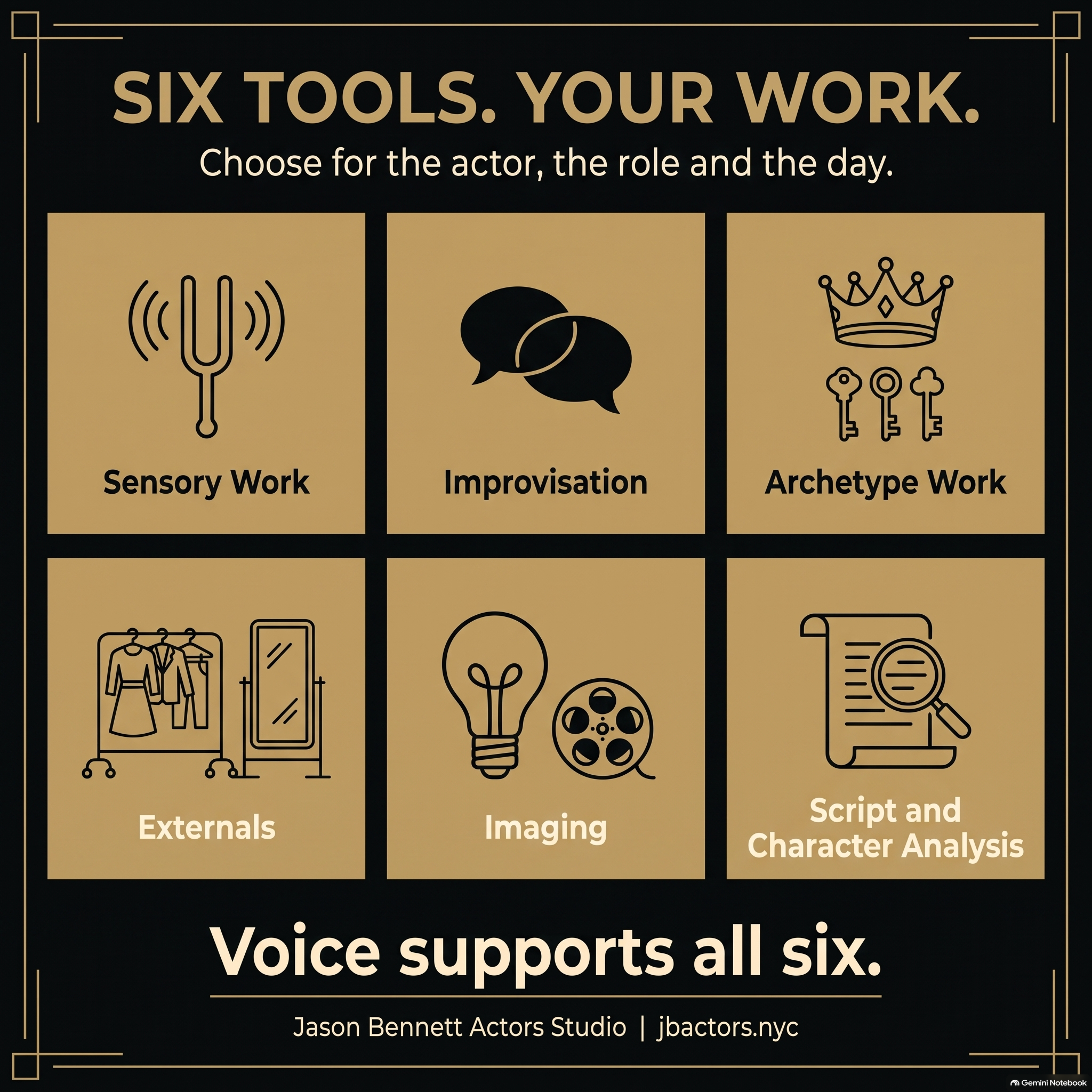
Jason Bennett teaches all six craft tools in JBAS classes and workshops: Sensory Work, Improvisation, Archetype Work, Externals, Imaging, and Script and Character Analysis. Voice supports all six. You learn to choose and combine them for your experience, your role and the work in front of you.
Related entries
Instrument, Objective, Tactic, Acting process.
Other training traditions may organize these terms differently.
Sources
Explore at JBAS
Dada
Dada was an international artistic movement that challenged inherited ideas about art, language, reason, and cultural authority. This introductory entry centers on its performance origins at Zurich’s Cabaret Voltaire, which opened on February 5, 1916, during the First World War. The venue’s historical account describes a mixture of poetry, music, dance, masks, and experiments with language. Cabaret Voltaire, history and program.
Those practices matter to an acting encyclopedia because Dada was performed as well as printed, exhibited, and debated. The relationship among body, sound, word, audience, and event was part of its artistic investigation. The opening date and Zurich focus do not describe every Dada group or its later development elsewhere.
An actor’s route into the subject
Study suggestion: Listen to a documented performance of a sound poem, with its attribution and historical context. Attend first to duration, breath, rhythm, repetition, and the performer’s relationship to the audience. Then read the contextual material and ask what your first hearing missed.
A new classroom experiment could use invented syllables to explore rhythm and ensemble response. It should be described as a contemporary exercise inspired by a particular source, not as an authentic reconstruction of a historical event or a complete definition of Dada.
Common confusion
“Random” is too small an explanation. An apparent disruption of ordinary meaning can involve deliberate choices, a specific occasion, and an argument about art or society. Dada also should not be treated as an interchangeable name for Surrealism, Futurism, absurdist drama, or any performance that appears strange. Those relationships require their own historical evidence.
Dada’s international history extends beyond its Zurich origins. Its other centers had distinct people, publications, performances, and political contexts; they should not be collapsed into one undifferentiated style.
Related entries
Futurism, Craft. Further subjects to explore: Hugo Ball, Emmy Hennings, Tristan Tzara, sound poetry, Cabaret Voltaire, performance manifesto.
Sources
Deadly theatre
Deadly theatre is Peter Brook's name for theatre that has gone dull through habit, respectability, and imitation of what worked before. It can live in a famous company as easily as a bad one. The danger, he argued, is that everyone involved, including the audience, mistakes the absence of life for seriousness or tradition.
In rehearsal
Rehearsal example: Find the moment in your scene you have played the same way for ten runs. Ask whether it is still being discovered or only repeated. Change one condition, such as where you stand or what you want from your partner, and see whether the moment wakes.
Sources
Peter Brook, The Empty Space (1968), "The Deadly Theatre."
Related entries
Holy theatre and rough theatre · Habit · Indicating and playing the result · Peter Brook
Defense mechanism
A process described in psychodynamic theories as protecting against anxiety or conflict, often outside awareness.
Connection to your acting. Ask what a character avoids knowing, then ground the possibility in behavior and language.
Disidentification
In the Psychology of Selves, disidentification means developing enough separation from a self to recognize its viewpoint as one influence rather than the whole of who you are. The self remains available. Its abilities, concerns and protective history do not have to be discarded.
Sidra Stone describes this separation as a way to retain the gifts of familiar primary selves while gaining access to qualities they have excluded. Replacing one compulsory identity with its opposite would leave the same problem of limited choice.
Connection to your acting. An actor accustomed to being agreeable can experiment with a clear refusal without making aggression a new rule. Try the refusal in the character’s circumstances, notice its effect on the partner, and keep the ability to soften or hold the boundary as the scene develops.
Sources. Sidra Stone, “One Secret of Graceful Aging: Separating From Primary Selves” (2005).
Disowned self
A disowned self, in the Stones’ framework, carries qualities that the primary self system treats as unacceptable or unsafe. “Disowned” describes this exclusion, not a judgment that the quality is bad. Tenderness, ambition, pleasure, restraint or authority can each be disowned in a different person.
The Stones distinguish a disowned self from a possibility that is simply unfamiliar or has not yet become relevant. Active rejection and lack of experience are different conditions. A role that feels unfamiliar does not by itself prove that the actor has disowned its qualities.
Connection to your acting. A performer who habitually makes every character forceful might investigate receiving help or waiting for an answer. Use the experiment to discover behavior the role needs. There is no requirement to diagnose the actor or disclose a personal history.
Sources. Hal and Sidra Stone, “What are primary selves and disowned selves?”; Hal and Sidra Stone, “What is the difference between a disowned self and an unconscious self?”.
Divided consciousness
Michael Chekhov described a higher self in the creative actor that watches and guides while the everyday self plays the part. You are fully inside the character's feelings and at the same time above them, aware of the audience, your partners, and the shape of the whole. He saw this double awareness as a source of compassion and of artistic control, protecting you from being swallowed by the role.
In rehearsal
Rehearsal example: During a heated run, keep one thread of attention on a single fact outside the scene, such as the tempo of the whole act or where your partner needs light. Afterward, notice whether the heat lessened or whether you could go further because someone was keeping watch.
Sources
Michael Chekhov, To the Actor (Harper & Row, 1953), "Creative Individuality."
Related entries
Aware Ego Process · Metacognition · Paradox of the actor · Michael Chekhov
Effort actions
Rudolf Laban analyzed movement through four factors: weight (strong or light), time (sudden or sustained), space (direct or indirect), and flow (bound or free). Combining the first three gives eight basic effort actions: press, wring, glide, float, punch, slash, dab, and flick. Actors use them to find a character's physical rhythm and to shift the quality of a moment without changing the words.
In rehearsal
Rehearsal example: Speak one line eight times, each time moving and speaking with a different effort action. A refusal that floats is a different person from a refusal that punches. Keep the one that tells the truth of the scene.
Sources
Rudolf Laban, The Mastery of Movement (1950; later editions revised by Lisa Ullmann).
Related entries
Embodied cognition
Approaches that investigate how thinking relates to bodily action and interaction with an environment.
Connection to your acting. Voice and movement can participate in discovery. This does not prove that every imaginative exercise has one established neurological explanation.
Emotion regulation
Processes that influence which emotions occur, their intensity or duration, and their expression.
Connection to your acting. A playable scene requires enough availability to respond; maximum emotional intensity is not a universal acting goal.
Emotional color
An emotional color is a feeling quality you explore while rehearsing the scene. You might try delight, embarrassment or irritation while keeping the same words and objective. In Bennett’s rehearsal process, this is a way to discover alternatives. You use what makes the encounter more specific and responsive, and let the feeling change when the partner or circumstances change.
In rehearsal
Play a request for an extension with amused confidence. Repeat it with embarrassment, then with irritation. Keep the same deadline and the same need for your partner’s agreement. Notice which version reveals a useful complication. Return to the scene without fixing a feeling in advance and allow the encounter to develop.
Sources
Jason Bennett, Rehearsal Process and Techniques, rev. December 22, 2005, exercise 20; Character and Story Worksheet, rev. September 28, 2006, questions 87–90.
Related entries
Improvisation · Objective · Indicating and playing the result
Emotional preparation
In Meisner's training, emotional preparation is the private work you do before an entrance so that you arrive already full of the life the scene needs. It is usually built through daydreaming: imagining circumstances, often personal or invented, that move you. Meisner stressed that preparation only lasts for the first moment; after that the scene and your partner carry you.
In rehearsal
Rehearsal example: Before an entrance where your character has just heard good news, spend two minutes imagining something you would truly be elated to hear. Do not plan how it should look. Enter and let your partner deal with whatever arrives.
Sources
Sanford Meisner and Dennis Longwell, Sanford Meisner on Acting (Vintage, 1987).
Related entries
Moment before · Personalization · Repetition exercise · Sanford Meisner
Empathy
Understanding or sharing aspects of another person's experience.
Connection to your acting. Imaginative contact with a role does not require agreement with every action the character takes.
End-gaining
End-gaining is F. M. Alexander's term for going straight for a result without attending to how you get there. The singer who reaches for a high note and tightens the neck, the actor who wants to look angry and clenches the jaw: both have gained the end and harmed the means. Alexander's alternative is to attend to the means-whereby, the process that produces the result.
In rehearsal
Rehearsal example: Pick the line in your scene where you most want a particular effect. Stop before it, notice what your neck and breath are doing, and choose not to grab. Let the line come from what you want from your partner instead of from the effect you hope for.
Sources
F. M. Alexander, The Use of the Self (1932).
Related entries
Inhibition (Alexander Technique) · Indicating and playing the result · Relaxation · F. M. Alexander
Endowment
Through endowment, you give a person, place or object a specific imagined history or significance that can matter to you in the scene. You work beyond its neutral appearance. A room becomes a place where something happened; an object becomes connected to someone. You explore the relationship through sensory detail and imaginative action.
In rehearsal
Choose a prop already needed in your scene. Imagine a small event that makes it meaningful to your character, such as receiving it as a gift. Rehearse the event with sensory detail, then handle the prop in the scene. Discover what the history changes without explaining the entire memory to the audience.
In the studio’s work
Bennett’s Tour of Two Places asks you to give imagined places memories; his worksheet extends this work to your relationship with the objects around you.
Sources
Jason Bennett, Exercises for Classes, “Tour of Two Places,” adapted there from Stella Adler; Character and Story Worksheet, question 144; Eric Morris, The Eric Morris System.
Related entries
Ensemble
An ensemble is a group of performers working in relation to one another and to the whole piece. You contribute your particular abilities while staying available to what the other people bring. In Bennett’s curriculum, ensemble development includes shared preparation, theater games and partner work that asks you to make contact through imagination and action.
In rehearsal
With your partner, improvise a short moment from the story using sound and movement before adding the lines. Allow what your partner does to alter your next impulse. Afterward, describe one moment when you were making something together and one when you stopped receiving each other. Use that observation in the next rehearsal.
In the studio’s work
You encounter ensemble work at the beginning of Bennett’s Study Progression and in the shared preparations on his rehearsal sheet.
Sources
Jason Bennett, Study Progression, rev. August 8, 2006, section I; Rehearsal Process and Techniques, exercises 3 and 16.
Related entries
Epic theatre
Epic theatre is Bertolt Brecht's model of a theatre that narrates rather than seduces. Where dramatic theatre pulls the spectator into feeling with the hero, epic theatre asks the spectator to observe, judge, and think about why things happen. It uses songs, captions, direct address, and episodic structure to keep the audience awake to the social causes behind what they see.
In rehearsal
Rehearsal example: Play a scene once as if it were happening to you now. Then play it as if you were reporting, later, what your character did and letting the audience decide whether it was right. Notice which choices become visible in the second version.
Sources
Bertolt Brecht, Brecht on Theatre, ed. and trans. John Willett (1964), including "The Modern Theatre Is the Epic Theatre" and "A Short Organum for the Theatre."
Related entries
Verfremdungseffekt · Gestus · Theatre convention · Bertolt Brecht
Event
An event is something that happens and changes the situation you are playing. A letter arrives, an accusation lands, an agreement breaks or a character understands something differently. You identify what changes and what that change makes you do next. Events give you concrete turning points through which the scene and the larger story develop.
In rehearsal
Find the moment when your character learns that the train has been canceled. Play the scene up to that information, take it in and continue toward your objective. Ask what is possible before the news and what is possible afterward. If your behavior barely changes, test what the canceled train costs this character now.
Sources
Jason Bennett, Character and Story Worksheet, rev. September 28, 2006, questions 9–11 and 42.
Related entries
Exile
An IFS part kept apart within the internal system for protection.
Connection to your acting. A fictional person's hidden vulnerability can be explored through the text without requiring personal disclosure from an actor.
Expectation
An expectation is what you anticipate will happen, including how you assume another person will respond. You may enter a scene expecting a welcome even when you know, as the actor, that the script contains a rejection. Your character’s expectation gives the event something to overturn. It can be as immediate as expecting an answer to your next question.
In rehearsal
Approach your scene partner expecting them to be delighted that you arrived early. Let that expectation shape your entrance. When their first line tells you they want privacy, receive the difference between what you anticipated and what happens. Continue working for your objective without preparing the disappointment before their response reaches you.
Sources
The Encyclopedia of Acting, historical studio compilation, “Expectation”; Jason Bennett, Character and Story Worksheet, rev. September 28, 2006, p. 4, question 50.
Related entries
Experiential-conceptual continuum
Bennett’s experiential-conceptual continuum names the movement between doing the work and thinking about its form. You can begin with sound, movement or an improvisation, then use analysis to shape what you discover. You can also return to experience when a planned interpretation becomes rigid. The balance depends on you, the material and the stage of rehearsal.
In rehearsal
Explore a confrontation for a minute using movement and sound. Notice one impulse that surprises you. Read the scene again and ask where that impulse fits the written circumstances. Rehearse the dialogue with that discovery available, then review what it contributes. Alternate a short experiment with a specific question about the text.
Sources
Jason Bennett, Acting Theory, Character and Story Worksheet and Rehearsal Process Workshop, copyright 2006, pp. 1–2; Rehearsal Process and Techniques, rev. December 22, 2005, introduction and exercise 63.
Related entries
Acting process · Improvisation · Script and character analysis
Explicit memory
Memory that can be consciously recalled, including events and factual knowledge.
Connection to your acting. Learning lines and remembering a rehearsal note involve different demands from the lived encounter in the scene.
Externals
Externals is a route into characterization through observable qualities and physical choices. An actor might investigate a person’s rhythm, an animal’s attention, the effect of a costume, or a particular way of occupying space, then explore how that changes the role.
In JBAS classes and workshops, you explore observation, animal work, changes of costume, hair and makeup, and application to scenes. Jason Bennett helps you connect these discoveries with movement, voice, imaginative life and the demands of your scene. Externals: how we teach the tool.
In rehearsal
Rehearsal example: Observe how a bird alternates stillness and quick changes of attention. Describe the rhythm without assigning it a human personality. In the studio, test a small equivalent in how a character listens. Then set aside the animal image and play the scene with the partner.
The useful result may be very small: a different delay before answering, a more definite stillness, or a sharper change of focus. The aim need not be recognizable imitation. The actor should be able to choose the scale of the result and let the scene determine whether it belongs.
A coat offers another kind of experiment. How does fastening it, carrying it, or protecting something inside it change the character’s task? The coat is useful when it enters the circumstances and relationship, not merely because it creates an interesting pose.
Avoiding caricature
Describe what you can actually observe. A disability, accent, age, or cultural identity does not reveal a person’s intelligence, morality, or inner life. A characterization becomes more specific through researched circumstances and contradictions, not through a bundle of borrowed stereotypes.
Externals can work alongside imaging, textual analysis, and action. The phrase “outside-in” describes a possible direction of exploration; it need not become a rule that inner and outer experience are separate compartments.
Related entries
Imaging, Archetype Work, Craft, Method of physical action.
Sources
Explore at JBAS
Feeling of ease
Michael Chekhov named four feelings an actor can cultivate in the body: ease, form, beauty, and the whole. Ease is the first. Heavy or tragic material played with lightness inside the instrument reads more powerfully than material played with strain, because effort shows and ease lets the meaning through. Ease is not lack of energy; it is energy without excess tension.
In rehearsal
Rehearsal example: Walk across the room carrying an imagined heavy weight. Then carry the same weight with ease in your body while the character still feels its burden. Speak a hard line from each state and compare.
Sources
Michael Chekhov, To the Actor (1953), "The Actor's Body and Psychology."
Related entries
Feeling of the whole · Relaxation · Qualities and sensations · Michael Chekhov
Feeling of the whole
The feeling of the whole is Chekhov's name for sensing any piece of work, a gesture, a scene, a performance, as having a beginning, a middle, and an end. When you carry that sense, each moment knows where it sits in the larger shape. It guards against playing every line at the same weight.
In rehearsal
Rehearsal example: Before a run, picture the whole play from your first entrance to your last exit in one minute. Then play your first scene and ask where in that larger arc it sits. Is it a rising, a turning, a fall?
Sources
Michael Chekhov, To the Actor (1953), "The Actor's Body and Psychology" and "Composition of the Performance."
Related entries
Feeling of ease · Through-line of action · Character arc · Perspective
Firefighter
An IFS protective part that responds when vulnerable parts are activated.
Connection to your acting. The term can clarify a model's argument. It does not diagnose a colleague's urgent behavior.
First reading of a play
Your first reading is your initial encounter with a play before its events become familiar. You can notice surprise, images, questions, attraction and resistance before deciding how to perform anything. Keeping those impressions gives you material to return to as you study and rehearse. Later discoveries can change your understanding while the first response remains one useful part of your process.
In rehearsal
After reading a play for the first time, write down three images, one moment that surprised you and a question you want to explore. Leave room beside each note. On your next reading, add what you discover without erasing the first impression. Choose one image and explore it briefly through sound or movement before returning to the text.
Sources
The Encyclopedia of Acting, historical studio compilation, “First Acquaintance with a Play”; Jason Bennett, Character and Story Worksheet, rev. September 28, 2006, p. 1, questions 4–6.
Related entries
Flow
A state of absorbed involvement in an activity, often discussed in relation to the balance of challenge and skill.
Connection to your acting. Create conditions for engaged work, then let the scene be an encounter. Flow cannot be guaranteed by ordering yourself to enter it.
Fourth wall
The fourth wall is the imagined wall between the stage and the audience in a realistic box set. Denis Diderot advised actors in 1758 to imagine such a wall and play as if the curtain had not risen. Uta Hagen later built an exercise around giving the fourth wall specific content, a window, a mirror, a view, so that your eyes land on real imagined objects instead of on the house.
In rehearsal
Rehearsal example: Decide exactly what is on your fourth wall: a painting, a window onto a street, a clock. When your character looks out front, look at that thing and let it mean something. Notice whether you stop seeing faces.
Sources
Denis Diderot, Discourse on Dramatic Poetry (1758); Uta Hagen with Haskel Frankel, A Challenge for the Actor (Scribner, 1991), the object exercises.
Related entries
Public solitude · Imaginary objects · Naturalism · Uta Hagen
Futurism
Futurism names artistic movements associated with modernity, speed, technology, and a break with inherited forms. This initial entry concerns Italian Futurism. Russian Futurism and other distinct histories require separate treatment rather than being silently folded into an Italian account.
Filippo Tommaso Marinetti launched the Italian movement through a manifesto published in Le Figaro in 1909. The Guggenheim’s account presents work across painting, sculpture, literature, performance, music, design, and other media, with the modern city and machine as important concerns. Guggenheim, Italian Futurism.
Its political history belongs in the explanation. Celebration of violence and war, and relationships between Futurism and Italian Fascism, cannot be omitted from a reference entry that discusses its formal experiments. The relationships also need historical precision; they should not be compressed into a claim that every artist and every phase had an identical position. Guggenheim, exhibition account.
Why it belongs in performance study
For actors: Futurism prompts questions about compression, simultaneity, noise, speed, the machine, and the audience’s experience of an event. Those questions can be useful to an actor or maker without requiring agreement with a manifesto’s politics.
For a first study exercise, compare the written description of a documented performance with a visual work from the same artist or circle. Identify the precise source and date. What evidence connects them? Which similarities are your interpretation? Avoid inventing a historical acting technique from a general impression of the paintings.
Studying Futurist theatre
Study The Futurist Synthetic Theatre alongside documented productions before drawing conclusions about actors’ methods. Keep a contemporary rehearsal experiment distinct from a reconstruction of a historical performance.
Related entries
Dada, Craft. Further subjects to explore: Marinetti, Futurist theatre, simultaneity, Luigi Russolo, Russian Futurism, performance manifesto.
Sources
Game
A game gives you a playable way to describe the contest inside a scene: what you are trying to win, how you recognize a gain and what a loss would mean. The game might concern attention, authority or belonging. You test this frame against the scene’s circumstances and your partner’s behavior, keeping the human need underneath it.
In rehearsal
Rehearse a dinner scene as a contest over who gets to choose the subject. Decide what would count as a gain for your character. Play the written dialogue and watch your partner. Afterward, name the moments when control changes. Try a different game, such as gaining an invitation, and compare what becomes clearer.
Sources
Jason Bennett, Character and Story Worksheet, rev. September 28, 2006, questions 44–48.
Related entries
Gesture
A gesture is a physical movement through which you can carry a thought, an impulse or an action. Reaching toward someone, withdrawing a hand or turning a palm can become part of how you relate. Jason Bennett asks you to connect the movement to a purpose. You can explore an ordinary gesture or a stylized one by asking what you are doing through it.
In rehearsal
Try to reassure your partner without touching them. Notice whether you offer a hand, make space beside you or move closer. Repeat the scene and let your partner’s response change the movement. If a gesture appears, give it a purpose in the exchange rather than repeating it because it looked expressive the first time.
Sources
The Encyclopedia of Acting, historical studio compilation credited to Jason Bennett and others, “Gesture.”
Related entries
Gestus
Gestus is Brecht's term for the social attitude a gesture or line reveals: not just what a character does, but the relationship of power, class, or need that the action shows. A man bowing to a superior shows a gestus of submission; the same bow given grudgingly shows a different one. The actor's task is to make that social meaning visible.
In rehearsal
Rehearsal example: Find the one physical action in your scene that best shows who has power. Strip everything else away and play only that action. Then put the scene back around it and see whether the power relationship reads more clearly.
Sources
Bertolt Brecht, "A Short Organum for the Theatre" (1948), in Brecht on Theatre, ed. and trans. John Willett (1964).
Related entries
Epic theatre · Status · Gesture · Psychological gesture · Bertolt Brecht
Given circumstances
Your given circumstances are the facts and conditions in which the action happens: time, place, events, relationships and the character’s situation. You identify what the script actually supplies before making additional imaginative choices. Those circumstances give your actions a context and help you understand why this moment matters to this person.
In rehearsal
Before rehearsing a scene, name its location, time and immediate preceding event. Find the evidence in the script. Fill an unanswered detail with a clearly chosen possibility, then rehearse it. Notice whether the choice fits the established facts and gives you more to respond to.
In the studio’s work
Bennett’s worksheet asks you to gather what the author, other characters and your own character say, then connect those facts to the specific time and place.
Sources
Jason Bennett’s teaching materials, “Given Circumstances”; Jason Bennett, Character and Story Worksheet, questions 7 and 92–96; Acting Theory, Character and Story Worksheet and Rehearsal Process Workshop, 2006, pp. 2–3.
Related entries
Guideposts
Michael Shurtleff gave auditioning actors twelve guideposts for reading a scene fast: relationship, conflict, the moment before, humor, opposites, discoveries, communication and competition, importance, events, place, game playing and role playing, and mystery and secret. His conflict guidepost is a single question, "What are you fighting for?", and he held that you should always fight for something positive. The guideposts give you a strong, specific reading in the minutes before you walk in.
In rehearsal
Rehearsal example: With a fresh audition side, give yourself ten minutes. Answer three guideposts only: relationship, what you are fighting for, and the moment before. Read the scene. Then add humor and discoveries and read it again.
Sources
Michael Shurtleff, Audition (Walker, 1978).
Related entries
Moment before · Opposites · Secret · Objective · Michael Shurtleff
Habit
A habit is a pattern you repeat until it becomes familiar and may happen without much conscious attention. In your acting, a habit might help you prepare or might narrow your choices: a dependable warm-up, a recurring rhythm, a smile that appears whenever a scene becomes uncomfortable. Training asks you to notice which habits support your work and which ones you want to change.
In rehearsal
Choose a short passage and notice whether you give every sentence the same falling pitch. Try it again with your attention on a different need in each sentence. Listen to your partner before continuing. Compare the pattern that returns automatically with the choices that arise from the exchange, then keep practicing the preparation that gives you more options.
Sources
The Encyclopedia of Acting, historical studio compilation credited to Jason Bennett and others, “Habit.”
Related entries
Habituation
A reduction in response with repeated exposure to a stimulus.
Connection to your acting. Repetition may make familiar material less surprising. Restore attention to the actual event instead of manufacturing a larger reaction.
Holy theatre and rough theatre
In The Empty Space, Peter Brook sets three living theatres against the deadly one. The holy theatre makes the invisible visible: ritual, sacred, reaching for something beyond words. The rough theatre is popular, earthy, noisy, and close to its audience, the theatre of the inn yard and the fairground. The immediate theatre is the one he builds from both, alive in the present moment of each performance.
In rehearsal
Rehearsal example: Play the same short scene twice. Once as a ritual, slow and sacred, as if something unseen were present. Once as a rough fairground turn, loud and direct with the audience. Keep whatever each version found that the other lacked.
Sources
Peter Brook, The Empty Space (1968), "The Holy Theatre," "The Rough Theatre," and "The Immediate Theatre."
Related entries
Deadly theatre · Theatricality · Theatre of Cruelty · Peter Brook
"I am"
"I am" is Stanislavski's name for the state in which you have placed yourself so fully in the imagined circumstances that you exist inside them. It grows from belief in small truthful actions. When enough small truths add up, you no longer pretend to be in the place; for the moment you are there, acting on your own responsibility.
In rehearsal
Rehearsal example: Choose a simple task in the scene, such as laying a table for a guest who may not come. Do each step truthfully, with real time and real weight. Notice the moment when the room stops being a set and starts being your character's home.
Sources
Konstantin Stanislavski, An Actor Prepares, trans. Hapgood, "Faith and a Sense of Truth."
Related entries
Artistic truth · Magic if · Given circumstances · Stanislavski
Iambic pentameter
Iambic pentameter is a line of verse built from five iambs, each an unstressed syllable followed by a stressed one: da-DUM da-DUM da-DUM da-DUM da-DUM. It is the basic line of Shakespeare's verse and close to the natural rhythm of English speech. Actors read where the line keeps the pattern and where it breaks it, because the breaks often mark a change of thought or feeling.
In rehearsal
Rehearsal example: Tap the beat of a verse speech on your thigh as you speak it. Mark every line where your tapping stumbles. Ask what is happening to the character at each stumble.
Sources
John Barton, Playing Shakespeare (1984); Cicely Berry, The Actor and the Text (1987).
Related entries
Ideal future
Your character’s ideal future is the life they hope to bring about. In Jason Bennett’s teaching, you give that future particular details so that wanting it becomes more than an abstract idea. You explore where the character hopes to be, with whom, and how life would feel if things went as they wished.
In rehearsal
Imagine a day after your character gets what they most want. Choose the place and the people who would be there. Rehearse a short part of that future with movement, sound and sensory detail. Return to the scene and let that possibility inform what you ask of your partner now.
In the studio’s work
Bennett’s worksheet asks you to image and rehearse ideal futures and possible victories with different outcomes.
Sources
Jason Bennett, “Ideal Future”; Jason Bennett, Character and Story Worksheet, questions 142 and 147–148; Rehearsal Process and Techniques, exercise 36.
Related entries
Identification
In the Psychology of Selves, identification occurs when a self’s priorities feel like the unquestioned viewpoint of “I.” Its preferences become ordinary assumptions about what is responsible, attractive, safe or possible. Identification can therefore be hardest to notice in abilities that have brought recognition or helped a person manage life.
The term concerns a relationship to a self, not merely having a feeling or using an ability. Being organized is different from experiencing every departure from organization as a threat to who you are.
Connection to your acting. A carefully prepared actor may assume that a spontaneous pause means the scene has gone wrong. Separate the useful skill of preparation from the rule that every moment must follow the plan. Then judge the pause by the circumstances and the partner’s action.
Sources. Hal and Sidra Stone, “Voice Dialogue: Discovering Our Selves” (2001).
IFS part
A subpersonality in Richard Schwartz's Internal Family Systems model.
Connection to your acting. Keep the term attached to IFS when comparing it with a Stone self or a scripted role.
Imaginary body
Chekhov's imaginary body is a body you imagine for the character, taller, heavier, rounder, sharper than your own, which you then step into like a costume. You do not force your body into the shape. You let the imagined body slowly influence how you move, speak, and feel, until the character's physical life emerges from it.
In rehearsal
Rehearsal example: Imagine your character's body standing in front of you. Note its height, weight, and the way it holds its head. Step into it and walk the room. Speak a few lines from inside it. Leave it behind when you finish and notice what lingers.
Sources
Michael Chekhov, To the Actor (1953), "Character and Characterization."
Related entries
Imaginary center · Characterization · Physicalization · Michael Chekhov
Imaginary center
An imaginary center is a point in or near the body from which the character's movement seems to come. Chekhov suggested placing it in the chest for an open, balanced figure, in the head for a thinker, in the belly or the knees or a few inches in front of the nose for comic or eccentric types. Moving the center changes the whole person without a single added gesture.
In rehearsal
Rehearsal example: Walk with your center in your chest. Move it to the tip of your nose. Then to your pelvis. Say the same greeting from each. Keep the one that best fits who your character is.
Sources
Michael Chekhov, To the Actor (1953), "Character and Characterization."
Related entries
Imaginary body · Characterization · Externals · Michael Chekhov
Imaginary objects
An imaginary object is a person, thing or presence you work with as part of an invented situation when it is not physically there. You can give it a location, qualities and significance. The rehearsal task is to develop your relation to it and the action it prompts. You can know that the object is imagined while responding to the circumstances you have created.
In rehearsal
Imagine that a small bird has entered the room and settled near an open window. Place it precisely and notice its movement. Try to guide it outside without frightening it. Let changes in the imagined bird’s position alter what you do. Keep returning to the task instead of checking whether you can produce a perfectly sharp mental picture.
Sources
The Encyclopedia of Acting, historical studio compilation credited to Jason Bennett and others, “Imaginary Objects of Attention” and “Imaginary Objects.”
Related entries
Imagination
Imagination is your capacity to create and explore people, places, events and possibilities beyond what is physically present. In acting, you work with those possibilities through your senses, body, voice and attention. You give the script a particular world you can respond to. In Stella Adler’s teaching, imagination is central to finding a character’s life beyond your personal past.
In rehearsal
Create one corner of your character’s home. Decide what is there, what you can hear and which object draws your attention. Explore the place as your character, using sensory questions and movement. Add a small event that belongs to the story, then let your response develop as you rehearse.
In the studio’s work
Bennett’s Tour of Two Places adapts Adler’s work through imaging, sensory detail and imagined events.
Sources
Jason Bennett, Exercises for Classes, “Tour of Two Places”; Stella Adler Studio of Acting, Core Beliefs: The Power of the Imagination.
Related entries
Imaging
In Jason Bennett’s teaching vocabulary, imaging means working with imagined sensory material to make a person, place, event, relationship, or atmosphere more available to the actor. The material may arise deliberately, through a daydream, or from a remembered dream. The word does not require that every actor experience a vivid internal picture.
Jason Bennett teaches Imaging as one of the six tools in JBAS classes and workshops. Jason Bennett’s articles also show how dream material can become a rehearsal resource. You explore what the image offers your acting; a dream need not have one fixed meaning. JBAS training approach and Imaging: how we teach the tool.
In rehearsal
Rehearsal example: The text refers to a room the audience never sees. Imagine one detail that matters to the character: a narrow window, the hum of a refrigerator, or the place where a chair used to stand. Speak the line about that room to a partner. Does the detail change the line’s intention, or does it distract you from the person listening?
If pictures are faint or absent, try a sense of space, a sound, a verbal description, or a concrete object used in rehearsal. The teaching question is what helps the actor engage with the circumstances. Vivid visual imagery is not a test of artistic worth.
Application and limits
An image need not be explained to an audience for its effect to matter. It must still serve the text, relationship, and performance. A private image that consistently overwhelms the scene or makes a partner inaccessible should be reconsidered.
Keep imagination distinct from factual research. An invented childhood room can be a rehearsal choice for a fictional character. It should not be presented as a documented detail about a real person without evidence.
Related entries
Externals, Archetype, Acting process, Craft.
Sources
Explore at JBAS
Implicit memory
Effects of previous experience expressed without deliberate recollection.
Connection to your acting. A practiced coordination can become available without verbally describing each step.
Improvisation
In improvisation, you create behavior as the work unfolds. You may begin with a clear situation and objective, or explore more freely through sound, movement and emerging impulse. Jason Bennett teaches improvisation as a broad tool for preparation, discovery, rehearsal and performance. The amount of structure changes with the task.
In rehearsal
Rehearse a scene in your own words while keeping the characters’ relationship and wants. Then alternate between your words and the written lines. Notice what becomes more immediate, and what the author’s words make possible that your paraphrase misses. Return to the text carrying the discoveries that fit.
In the studio’s work
You find this movement between free exploration and form throughout Bennett’s rehearsal process, including sound-and-movement work and improvised past events.
Sources
Jason Bennett, second “Improvisation” entry; Jason Bennett, Rehearsal Process and Techniques, exercises 16, 18–19 and 37.
Related entries
Independent activity
In Meisner training, an independent activity is a difficult, specific task you take on that has urgent meaning for you, such as repairing a broken object before a deadline. A partner then enters and the repetition exercise begins while you work. The activity keeps you busy with something real, and the conflict between finishing it and dealing with your partner creates genuine behavior.
In rehearsal
Rehearsal example: Choose a task that is truly hard: gluing a shattered plate in two minutes. Give yourself a reason it matters. When your partner enters, let them interrupt you. Do not drop the plate to play the scene.
Sources
Sanford Meisner and Dennis Longwell, Sanford Meisner on Acting (1987).
Related entries
Repetition exercise · Reality of doing · Activity · Urgency · Sanford Meisner
Indicating and playing the result
You may hear “indicating” when a teacher thinks you are showing an idea of a feeling or action instead of engaging with the scene. Jason Bennett questions the usefulness of that label and explicitly says it is not the studio’s vocabulary. His practical question is whether your behavior serves the story. “Playing the result” names the related problem of aiming at a predetermined outward effect.
In rehearsal
If you find yourself planning a tear, a pause or an impressive sound, return to what you want from your partner and what stands in the way. Try the scene with a different action. Notice which behavior grows from the exchange and which you keep repeating regardless of what your partner does.
In the studio’s work
In Jason Bennett’s teaching, you evaluate the fit between behavior and story rather than treating your impulses as inherently false. His rehearsal sheet asks you to try different actions and stay attentive to your partner.
Sources
Jason Bennett, “Indicating”; Jason Bennett, Rehearsal Process and Techniques, exercises 33 and 40; Lee Strasberg Theatre & Film Institute, Breaking Down Lee’s Work, on predetermined emotional manifestations.
Related entries
Individuation
Jung's account of psychological development toward a more differentiated and integrated relation among aspects of the psyche.
Connection to your acting. Use it to understand an author's argument about development. A character arc need not be a successful course of individuation.
Inhibition (Alexander Technique)
In F. M. Alexander's work, inhibition has nothing to do with shyness. It means pausing before a habitual response so you can choose a better one. Alexander linked it to the primary control, the relationship of head, neck, and back that governs the use of the whole body. By refusing the old reflex, such as pulling the head back to speak, you give the primary control a chance to work freely.
In rehearsal
Rehearsal example: Before your first line, notice the instant you begin to prepare to speak. Stop. Let your neck be free and your head balance. Then speak. Repeat until the pause is too small for anyone else to see.
Sources
F. M. Alexander, The Use of the Self (1932).
Related entries
End-gaining · Habit · Instrument · Natural voice · F. M. Alexander
Inner creative state
The inner creative state is Stanislavski's name for the condition in which all the elements of the system, attention, relaxation, belief, objectives, communion, imagination, come together at once. It is the working state in which inspiration becomes likely. He contrasted it with the false theatrical state an actor falls into when the elements are missing and only habit remains.
In rehearsal
Rehearsal example: Before a run, check four things in under a minute: Is my body free? Where is my attention? What do I want? Do I believe where I am? Begin only when you can answer each.
Sources
Konstantin Stanislavski, An Actor Prepares, trans. Hapgood, "The Inner Creative State."
Related entries
Inner motive forces · Concentration · Relaxation · Flow · Stanislavski
Inner critic
For Hal and Sidra Stone, the Inner Critic is a self that evaluates and attacks the person from within. They distinguish it from the Judge, their name for criticism directed at other people. Its standards are learned from relationships and culture, so its demands differ among individuals.
The Stones describe a protective intention beneath many critic attacks: preventing rejection, shame or failure by detecting faults first. That intention does not make the judgments accurate. The critic can issue contradictory demands, such as requiring visibility and condemning any attempt to attract attention.
Connection to your acting. After an audition, separate a usable observation, “I rushed the last sentence,” from “I am hopeless.” The first permits an experiment with pace and thought; the second gives no clear direction. Preserve exacting craft standards while questioning the claim that one performance determines personal worth.
Inner monologue
An inner monologue is the stream of thought you imagine beneath and between a character’s spoken lines. You can use it to explore what occupies the character’s attention, what remains unsaid and how the partner changes that thinking. In rehearsal, you may speak those thoughts aloud, then return to the script with the inner activity available.
In rehearsal
Take a scene in which you say, “I’m glad you came.” Before speaking the line, try the thought “Please stay longer this time.” Let your partner answer and allow your next private thought to change. Run the scene once with selected thoughts spoken aloud, then return to the written words while continuing to listen.
Sources
Jason Bennett, Character and Story Worksheet, rev. September 28, 2006, questions 67, 100 and 101.
Related entries
Inner motive forces
Stanislavski named three inner motive forces that drive the actor's psychological life: mind, will, and feeling. Each can awaken the others. A thought about the circumstances can stir a wish, a wish can stir feeling, and feeling can sharpen thought. Because feeling cannot be commanded directly, he advised reaching it through the mind and the will.
In rehearsal
Rehearsal example: When a scene feels flat, do not chase the emotion. Ask a mind question (what do I understand about this situation?) and a will question (what must I get?). Play the answers and let feeling arrive on its own.
Sources
Konstantin Stanislavski, An Actor Prepares, trans. Hapgood, "Inner Motive Forces."
Related entries
Inner creative state · Unbroken line · Objective · Affect · Stanislavski
Inner patriarch
Sidra Stone uses Inner Patriarch for an internalized voice that enforces patriarchal expectations about gender, authority, achievement and relationship. It may judge the same behavior differently depending on whether a woman or a man performs it. In her account, this voice can operate in people of different genders, including those who consciously reject its rules.
The concept identifies inherited standards that can feel like personal truth. A character’s specific history and social world determine whether the concept illuminates the writing; the label should not replace that investigation.
Connection to your acting. If a character praises assertiveness in a son but condemns it in a daughter, identify the actual words, consequences and expectations in the scene. Explore how the character defends that double standard and what happens when it is challenged. Avoid making every traditional or powerful character the same type.
Sources. Sidra Stone, “The Inner Patriarchy and Politics” (2016).
Instrument
In actor training, the instrument is the performer’s capacity to notice, imagine, respond, speak, move, and act. It includes the body and voice, attention, feeling, imagination, and the patterns that make expression available or difficult. The word is a teaching metaphor. A person has needs, choices, and limits that a musical instrument does not.
In Jason Bennett’s system, instrumental work is the first of three connected phases: Instrumental, Craft, and Business. A performer may understand a scene intellectually while finding that the voice tightens, the body becomes rigid, or the imagination goes quiet in front of other people. Instrumental practice addresses that practical gap. The aim is greater expressive availability, range, and independence.
Eric Morris also distinguishes work on the actor’s instrument from work on the dramatic material. His account places obstacles to expression within the first area and performance requirements within the second. That is one important lineage for the distinction used at Jason Bennett Actors Studio (JBAS). Eric Morris, official biography.
In rehearsal
Rehearsal example: You have prepared a persuasive argument for a scene. During the run, you notice you cannot finish a sentence without rushing. Before adding another psychological explanation, test a smaller change: take an unhurried moment to see your partner and then speak one complete thought. Compare what happens to intelligibility, listening, and the argument.
This example does not prescribe one cure for rushing. It demonstrates a diagnostic question: is the immediate difficulty in the interpretation, in expressive availability, or in both?
Instrumental work can continue throughout an actor’s life. The three phases are a way to organize attention, not a rule that someone must be completely “liberated” before doing a scene. Emotional intensity alone does not demonstrate readiness, skill, or useful progress.
Related entries
Craft, Acting process, Personal Inventory, Archetype Work.
Sources
Explore at JBAS
Instrumental work
Instrumental work is the practice through which you prepare and develop yourself for acting: your body, voice, senses, imagination and emotional availability. You attend to what helps or obstructs your ability to work before choosing how to fulfill a role. In Eric Morris’s system, instrumental preparation and craft are connected parts of an actor’s practice.
In rehearsal
Before a scene, take stock of what is present in you. Notice physical tension, the ease of your voice, your attention and your feelings. Choose a familiar warm-up or preparation that answers an actual need. Then enter the scene and notice whether you can receive your partner more readily.
In the studio’s work
Bennett’s Study Progression begins with instrumental and ensemble development, then includes self-regulated instrumental workouts alongside craft study.
Sources
Jason Bennett, Study Progression, sections I–III; Eric Morris, The Eric Morris System, preliminary preparations.
Related entries
Interoception
Perception of signals from within the body.
Connection to your acting. Notice internal sensations as information during voice preparation without treating every sensation as an instruction to intensify.
Intrinsic motivation
Engaging in an activity for its inherent interest or satisfaction.
Connection to your acting. Singing, play and rehearsal can matter as experiences in themselves. An external reward need not be their only reason.
Justification
Justification is how you make the circumstances and actions meaningful enough to live in them. You find a reason for what you do, why you need it and why it happens now. In Bennett’s exercises, you develop those reasons through a particular imagined situation and action, so that an entrance or gesture belongs to a life.
In rehearsal
Plan a short entrance, a task and an exit. Decide what you need to accomplish, why it matters now and what makes it difficult. Rehearse the sequence in a specific imagined place. If an action feels arbitrary, revisit the circumstances and try another reason that fits them.
In the studio’s work
Bennett’s “Creating Actions with Justifying Circumstances” exercise joins the objective, urgency, action and obstacle in one short event.
Sources
Jason Bennett, Exercises for Classes, “Creating Actions with Justifying Circumstances”; Jason Bennett’s teaching materials, “Justification.”
Related entries
Kabuki
Kabuki is a Japanese performance tradition in which acting, music, dance, staging, and visual design work together. Its history extends from the early seventeenth century, and its repertoire and performance practices continue to develop. It is a living tradition with its own knowledge and practitioners. Japan Arts Council, An Invitation to Kabuki.
The Japan Arts Council’s educational material introduces role specializations, distinctive makeup and costume, the mie pose, and stage arrangements such as the hanamichi passage through the audience. These are connected aspects of a theatrical language. A single pose or costume cannot stand in for that whole language.
Onnagata refers to specialists in female roles within Kabuki. The Council’s guide discusses a developed vocabulary of movement, gesture, voice, and costume. It should be studied within that performance history rather than reduced to an exercise in “acting feminine.” Japan Arts Council, Female roles.
Why actors should study it
For actors: Kabuki offers a valuable challenge to the assumption that truthful or powerful acting must resemble everyday behavior. It invites attention to how a trained audience reads pattern, timing, scale, and convention. That is a question to investigate through actual performances and practitioner explanations, not a conclusion that all theatrical styles work in the same way.
For an introductory viewing, choose a legitimately available performance excerpt with reliable contextual notes. Record what you can observe: a held position, a musical response, a change of pace, the audience’s relation to an entrance. Then distinguish those observations from meanings you have not yet learned.
Copying an isolated movement is not equivalent to learning the form. Comparative exercises should identify their limited purpose and credit the tradition and source performance.
Related entries
Craft, Externals. Further subjects to explore: mie, onnagata, hanamichi, aragoto, wagoto, Japanese performance histories.
Sources
Life conditions
In Gravesian and Spiral Dynamics terminology, the conditions of existence to which ways of thinking adapt.
Connection to your acting. Read the material circumstances carefully: scarcity, danger, belonging, work and institutions may ask different things of a character.
Listening
Listening in a scene means receiving what your partner gives you and allowing it to affect what happens next. You attend to the words, sounds and changes in the person in front of you. In Bennett’s rehearsal instructions, receiving a line has its own time and importance; it is part of your work, even when you are not speaking.
In rehearsal
Read a short exchange slowly with your partner. Take your line from the page, then give it to them. When they reply, receive the line before looking back down. Notice a change in their sound or behavior and allow it to matter before your next line.
In the studio’s work
Bennett’s partner-reading exercise asks you to keep contact while giving and receiving the text. Another rehearsal variation directs your attention to your partner’s movements and changes.
Sources
Jason Bennett, Rehearsal Process and Techniques, exercises 33 and 38.
Related entries
Logic and continuity
Logic and continuity are the connections that let you carry a sequence of actions from one moment to the next. You leave because you have received a message; you return because you discover something you need. Your character can be confused or contradictory while you still make those connections specific. The sequence gives you a practical path through a demanding scene.
In rehearsal
Rehearse leaving a room to catch a train. Check the time, collect what you need, notice something missing and decide what to do about it. Then add the scene’s dialogue while retaining the reason each action follows the last. Let your partner interrupt the sequence and discover how you continue, instead of preserving every movement unchanged.
Sources
The Encyclopedia of Acting, historical studio compilation credited to Jason Bennett and others, “Logic and Continuity.”
Related entries
Method of physical action · Through-line of action · Given circumstances
Magic if
The magic if invites you to ask how you would act if the circumstances of the scene were real. You use a possibility to enter imaginative action while remaining aware that you are performing. Jason Bennett’s teaching materials identify this tool with Stanislavski and also call it “as if.”
In rehearsal
Take an ordinary rehearsal task and change one circumstance in your imagination. What if the person you are waiting for could arrive at any moment? What do you do with the room, the objects and the time? Explore the consequences through action, then connect the useful discoveries to the script.
In the studio’s work
You meet related work in Bennett’s exercises for creating actions from imagined circumstances and in his questions about the character’s situation before a scene.
Sources
Konstantin Stanislavski, An Actor Prepares, “Imagination”; Jason Bennett’s teaching materials, “As If” and “Magic If”; Jason Bennett, Exercises for Classes, “Creating Actions with Justifying Circumstances.”
Related entries
Manager
An IFS protective part organized around preventing vulnerable parts from becoming activated.
Connection to your acting. For reading a character, distinguish anticipating danger from responding after an event.
Masking
Masking is the work of managing how your character appears to other people and to themselves. You consider the impression the character wants to create and the impression they need to avoid. That effort can shape speech, posture, attention and action. You can play the effort to maintain an appearance while allowing the scene to put it under pressure.
In rehearsal
Rehearse asking for help while trying to appear completely in control. Choose the person whose opinion matters and what you fear they might notice. Let your partner question you. Watch where the effort to preserve your appearance changes the way you ask, rather than planning a facial expression to hold throughout.
Sources
Jason Bennett, Character and Story Worksheet, rev. September 28, 2006, questions 71–77.
Related entries
Maslow's hierarchy of needs
Abraham Maslow's theory relates motivation to bodily needs, safety, belonging, esteem and the development of capacity. It is a theoretical account, not a checklist everyone completes in the same order.
Connection to your acting. Ask which need becomes urgent in the scene and what threatens it. A person can make art while other needs remain unmet.
Metacognition
Awareness and regulation of one's own thinking and learning.
Connection to your acting. Review which preparation helped after a run. Avoid turning the scene itself into a running review of your technique.
Method of physical action
The method of physical action is an approach associated with Stanislavski’s later work in which purposeful action within imagined circumstances becomes a route into the life of a role. This working definition connects the physical task with its reason and circumstances. Moving around the stage by itself does not explain the approach.
Jean Benedetti’s Stanislavski and the Actor: The Method of Physical Action brings together an account of the method, rehearsal discussion, and material from Stanislavski’s late teaching. Its contents explicitly connect physical action with mental action, interaction, verbal action, and characterization. Routledge, publisher description and contents.
A rehearsal question
Independent example, not a Stanislavski exercise: A character packs a bag before someone returns. What must be packed? What must remain hidden? What makes the task urgent? A series of purposeful, specific actions can create a different investigation from trying to display “panic” on cue.
Now change one circumstance: the character wants the returning person to discover the packed bag. The same objects may acquire a different use. The point of the comparison is the relationship among action, purpose, attention, and imagined circumstances.
Common confusion
Physical action should not be reduced to busy stage business or to a promise that a movement will reliably manufacture an emotion. “The Method,” emotional memory, and the method of physical action are not synonyms. Their histories and uses need to be distinguished.
Related entries
Stanislavski, Objective, Acting process, Externals.
Sources
Explore at JBAS
Mimesis
Mimesis is the Greek word Aristotle used for imitation or representation, the way art represents human action. He argued that imitation is natural to people from childhood and that we learn and take pleasure through it. For the actor, mimesis is the oldest name for the work: representing human action so that an audience recognizes itself.
In rehearsal
Rehearsal example: Watch one person on the street for a minute: their walk, their hands, their rhythm. In rehearsal, reproduce one detail exactly. Then ask what inner action that detail implies, and play the action, not the copy.
Sources
Aristotle, Poetics, chapters 1 to 4.
Related entries
Moment before
The moment before is the immediate life your character brings into the opening of the scene. You establish where you have been, what you were doing and what has just happened. Your first line then continues an experience already in motion. You work from the script’s facts and develop unanswered details through imagination.
In rehearsal
Choose an event just before your character enters. Rehearse the last small action from that event, then continue into the entrance and first line without resetting yourself. Try another plausible version. Compare how each changes your attention, pace and need for the other person.
In the studio’s work
Bennett’s worksheet asks what you were doing just before each scene, where you are coming from and how you feel; his theory sheet extends the inquiry to the preceding day.
Sources
Jason Bennett, Character and Story Worksheet, questions 88–93; Acting Theory, Character and Story Worksheet and Rehearsal Process Workshop, pp. 2–3.
Related entries
Natural voice
The natural voice, in Kristin Linklater's teaching, is the voice you were born with before habit, tension, and self-protection began to restrict it. Her work aims less at building a voice than at removing what blocks it, so that breath, sound, and feeling are directly connected. A free voice can carry the full range of a person's thought and emotion.
In rehearsal
Rehearsal example: Lie on the floor and let breath drop in and out without help. Release a sigh of relief on a soft "huh." Then speak a line on the same released breath. Notice what tension wants to come back as you stand and face a partner.
Sources
Kristin Linklater, Freeing the Natural Voice (1976; revised and expanded ed., Drama Publishers, 2006).
Related entries
Breathing · Instrument · Resonators · Inhibition (Alexander Technique) · Kristin Linklater
Naturalism
In this discussion of naturalism, you examine the pursuit of detailed resemblance to ordinary life onstage: the props, sounds, clothing and activities of a particular world. The entry questions detail added for its own sake. For your rehearsal, the useful test is whether each detail belongs to the circumstances and gives you something to respond to or do.
In rehearsal
Set a scene in a kitchen and choose one ordinary activity that fits its circumstances, such as drying a cup. Rehearse the conversation while doing it. Notice when the task helps you avoid, invite or delay contact with your partner. Add another detail only if it changes the work. Compare a fully furnished version with a simpler rehearsal setup.
Sources
The Encyclopedia of Acting, historical studio compilation credited to Jason Bennett and others, “Naturalism.”
Related entries
Neutral mask
The neutral mask, central to Jacques Lecoq's teaching, is a calm, balanced, expressionless mask that has no past and no personal history. Wearing it, you meet the world as if for the first time: waking, discovering the sea, crossing a landscape. It strips away personal mannerisms and teaches economy, presence, and the body's capacity to express without explanation.
In rehearsal
Rehearsal example: Without a mask, walk to the edge of the room as if seeing the ocean for the first time. Remove every gesture that tells the audience what you feel. Keep only what the discovery does to your body.
Sources
Jacques Lecoq, The Moving Body (Le Corps poétique, 1997; English trans. David Bradby, Methuen, 2000).
Related entries
Masking · Restraint in gesture · Physicalization · Jacques Lecoq
Objective
An objective is a change a character is trying to bring about at a particular point in a scene. It gives the actor something to pursue. The Tasmanian Drama Foundations glossary describes it as a temporary desire or goal within a scene and also uses “intention.” TASC, Drama Foundations glossary.
One useful formulation focuses on another person: what do I want you to do? A BYU teaching lesson uses that relationship to turn an objective into a playable proposition. This is a practical formulation, not a requirement that every dramatic action involve another visible person. BYU Theatre Education Database, Formalizing Tactics and Objectives.
In rehearsal
Rehearsal example: “I want security” identifies a broad need. “I want you to give me the spare key before you leave” places that need in an immediate event. The scene can now contain refusals, negotiation, concealment, and changed attempts.
Keep the distinction between evidence and choice. If the script establishes that the character asks for a key, the request is a fact of the scene. The belief that the key represents reassurance may be an interpretation. Test that interpretation against the rest of the play and the rehearsal.
An objective is different from a tactic. The objective might stay the same while the character tries humor, a promise, or a threat. It also differs from a desired emotional display: “look desperate” directs the actor toward an appearance without specifying what the character is attempting.
Terms vary
Goal, intention, task, objective, and super-objective can overlap in particular teachers’ vocabularies. They are not automatically interchangeable in every text. Jean Benedetti’s translation of Stanislavski uses “Bits and tasks” as a chapter heading; a comparison should identify the translation and the passage involved. Routledge, An Actor’s Work.
Related entries
Obstacle, Tactic, Beat, Robert Cohen.
Sources
- TASC, Drama Foundations glossary
- BYU Theatre Education Database, Formalizing Tactics and Objectives
- Routledge, An Actor’s Work
Explore at JBAS
Obligation
In Eric Morris’s craft vocabulary, an obligation is something the dramatic material asks you to fulfill. You may need to create a particular relationship, place, physical condition or emotional life. You identify the requirement, choose something that can engage you, then choose a way of working with it. That gives your preparation a concrete purpose.
In rehearsal
Make a short list of what one scene requires of you. Choose a requirement that is not yet present in your work, such as a meaningful relationship to the room. Select a preparation you know, rehearse it, then enter the scene. Assess whether it helps you fulfill that requirement while staying with your partner.
In the studio’s work
Bennett’s theory handout asks you to chart obligations and the processes you will use to meet them. It directs you to Morris’s Irreverent Acting.
Sources
Eric Morris, Irreverent Acting, as described in Morris’s book guide; Jason Bennett, Acting Theory, Character and Story Worksheet and Rehearsal Process Workshop, pp. 3–5.
Related entries
Observation
Observation is the practice of attending closely enough to discover particulars you might otherwise overlook. You notice movement, sound, shape, timing and relation. In Bennett’s exercises, observation supplies material for imagination and characterization. You distinguish what you actually perceive from the story you imagine about it.
In rehearsal
Study a leaf, a piece of fabric or another ordinary object. Notice its shape, surface, color and movement before describing it. Then watch your partner carry out a simple task, with their agreement. Name what you observed and separate those details from any story you invented about their feelings.
In the studio’s work
The “Observation” entry begins with close attention to nature. Bennett’s rehearsal sheet asks you to notice your partner’s every movement and change.
Sources
Jason Bennett, “Observation”; Jason Bennett, Rehearsal Process and Techniques, exercise 33; Exercises for Classes, “The Stories People Tell.”
Related entries
Obstacle
An obstacle is something that makes a character’s pursuit difficult. It can involve another person, a physical circumstance, a rule, limited time, incomplete information, or competing impulses. Its dramatic importance comes from its relationship to what the character is trying to do. The TASC glossary connects obstacles with a character’s struggle to pursue an action or objective. TASC, Drama Foundations glossary.
In rehearsal
Rehearsal example: A character wants a colleague to correct a false statement before a meeting ends. The colleague’s refusal is one obstacle. The chair’s attempt to move to the next item is another. The character’s own fear of losing the job may complicate the attempt further.
These are different kinds of difficulty. Naming each one can produce a different playable response: challenge the colleague, delay the meeting, offer evidence, or begin indirectly. “The scene is tense” describes an effect. Identifying the resistance helps explain what creates it.
An obstacle should affect behavior. If a rehearsal note says the character is afraid of being overheard, investigate whether that changes distance, timing, attention, or choice of words. If nothing changes, the note may be decorative, unsupported, or still unexplored.
Do not manufacture resistance simply to make every moment strenuous. Some scenes turn on ease, apparent cooperation, an unexpectedly granted wish, or the discovery that an assumed obstacle is absent. An actor should stay available to those events too.
Relationship to other terms
An obstacle is not the same as a tactic. A locked cabinet may prevent someone from getting a letter; flattering its owner is one possible attempt to overcome that resistance. Nor is every obstacle a villain. Another character can have an understandable goal that conflicts with yours.
Robert Cohen’s Acting One/Acting Two explicitly places Goal and Obstacle together in a lesson. McGraw Hill, book contents.
Related entries
Sources
Explore at JBAS
Offer and block
In Keith Johnstone's improvisation teaching, an offer is anything an actor says or does that gives the scene something to build on. A block is anything that rejects or ignores it. Scenes grow when actors accept offers; they die when actors block, often out of fear of where the scene might lead. Johnstone observed that blocking is a way of keeping control and staying safe.
In rehearsal
Rehearsal example: Improvise for two minutes where you must accept every offer your partner makes, however strange. Afterward, improvise two minutes where you notice your urge to block and accept anyway. Compare where each scene went.
Sources
Keith Johnstone, Impro: Improvisation and the Theatre (Faber, 1979), "Spontaneity" and "Narrative Skills."
Related entries
Operative word
The operative word is the word in a phrase that carries the thought, the one that must reach the listener for the sentence to make sense. Stanislavski's speech chapters treat finding it as basic to clear expression, and voice teachers since have used the term widely. Stressing every word stresses none; finding the operative one lets the rest of the line fall into place.
In rehearsal
Rehearsal example: Say "I didn't say you stole the money" seven times, stressing a different word each time. Hear the seven meanings. Then go through your own speech and find the one word in each sentence the scene cannot do without.
Sources
Konstantin Stanislavski, Building a Character, trans. Hapgood (1949), "Accentuation: The Expressive Word"; Cicely Berry, Voice and the Actor (1973).
Related entries
Opposites
In the Stones’ work, opposites are contrasting selves or ways of organizing experience: for example, responsibility and play, connection and independence, or control and spontaneity. One side may be familiar and authoritative while the other is excluded. The pairing depends on the person and situation.
The work does not require a compromise personality in which differences disappear. The facilitator lets each self clarify its position; the Aware Ego Process develops through experiencing the tension and making choices with access to both.
Connection to your acting. A character may want both intimacy and freedom. Rehearse what the character does to obtain each, and locate the moment when one need interferes with the other. Keep the contradiction alive through action instead of averaging it into a vague mood.
Sources. Hal and Sidra Stone, “Voice Dialogue: An Introduction to the Use of Voice Dialogue” (1994).
Paradox of the actor
Denis Diderot argued that the greatest actors do not feel the emotions they portray in the moment; they reproduce them with judgment and control, which is why they can repeat a great performance night after night. Actors who rely on raw sensibility, he claimed, are uneven. The argument started a debate about feeling versus technique that every acting tradition since has entered.
In rehearsal
Rehearsal example: Play an emotional moment once from full feeling and once from precise technique: exact timing, breath, focus. Repeat each three times. Notice which version holds up and which version the audience believes.
Sources
Denis Diderot, Paradoxe sur le comédien, written about 1773, published 1830.
Related entries
Divided consciousness · Emotion regulation · Representation acting · Craft
Peripeteia and anagnorisis
In Aristotle's account, peripeteia is the reversal, a sudden shift of the action into its opposite, and anagnorisis is the recognition, the change from ignorance to knowledge. He held that the finest plots join them, as when Oedipus learns who he is and his fortune turns at the same instant. For actors these are the hinges of a play, the moments everything else is built to reach.
In rehearsal
Rehearsal example: Find the line where your character learns the thing that changes everything. Play everything before it as if you will never learn it. Let the recognition land fully before you speak again.
Sources
Aristotle, Poetics, chapter 11.
Related entries
Persona
In Jungian psychology, the social face through which a person relates to the outer world.
Connection to your acting. For a character, compare the manner presented at work, at home and under pressure.
Personal Inventory
Personal Inventory is a practice of noticing and expressing what is actually present before trying to impose a performance state. The practice attends to physical sensations, feeling, thought, and the actor’s changing experience. The exercise comes from Eric Morris’s work; see No Acting Please.
That book is coauthored by Eric Morris and Joan Hotchkis. Morris’s official book page confirms the coauthorship and describes its focus on the actor’s obstacles and a “being state.” Eric Morris, official books page.
What the distinction makes possible
An actor may arrive expecting to feel brave and discover that they feel tired, distracted, or impatient. In the teaching logic of the inventory, those observations are information. Naming them can provide a more honest starting point than pretending they are absent. The purpose is not to award points for confession or to demand an intense emotional disclosure.
Rehearsal illustration: Before rehearsal, write three plain observations: “My shoulders feel raised”; “I keep thinking about the train”; “I want to rush this.” Then identify one practical condition you can change, such as putting the phone away or allowing time to read the first exchange. This is a separate reflection prompt, not Morris’s Personal Inventory exercise.
Common confusion
Personal Inventory here is an acting term with a named teaching lineage. It should not automatically be equated with a clinical assessment, an addiction-recovery inventory, or a moral judgment about the person. Those uses of “inventory” belong to different contexts.
The actor should also retain a choice about what remains private. A useful preparation does not require sharing everything noticed with a teacher, partner, class, or AI system.
Related entries
Instrument, Eric Morris, Acting process.
Sources
Explore at JBAS
Personalization
In Bennett’s worksheet, personalization means imagining an experience that could matter to you in a way parallel to the character’s situation. You build a personal connection through possibility. This differs from his separate substitution prompt, which asks you to choose an event from your actual past. You can explore either tool according to what the material and your practice need.
In rehearsal
Choose a moment when your character needs someone to believe them. Imagine a situation in which being believed would matter deeply to you. Give that situation a place, a person and a reason for urgency. Explore it briefly, then return to the character’s circumstances and let the connection serve the written scene.
In the studio’s work
Bennett’s worksheet explicitly connects this imaginative form of personalization with Adler and Meisner, while identifying the memory-based prompt separately.
Sources
Jason Bennett, Character and Story Worksheet, questions 26–27; Exercises for Classes, “Tour of Two Places,” adapted there from Stella Adler.
Related entries
Perspective
Stanislavski distinguished the perspective of the role, the long line of the character's life through the play, from the perspective of the actor, your knowledge of the whole shape and how to distribute energy across it. The character does not know how the story ends. You do. Perspective lets you hold back early so that the climax has somewhere to go.
In rehearsal
Rehearsal example: Mark the peak of your role. Play your first scene at a level that leaves room to rise. If you are already at full force in act one, ask what is left for the end.
Sources
Konstantin Stanislavski, Building a Character, trans. Hapgood (1949), "Perspective in Character Building."
Related entries
Feeling of the whole · Through-line of action · Super-objective · Stanislavski
Physicalization
Physicalization is how you give a character’s life a bodily form. You explore posture, balance, movement, tension, habits and the ways the character handles objects or meets other people. You ask what each physical choice communicates and what purpose it serves. A useful choice stays responsive to the scene and fits the material’s style.
In rehearsal
Rehearse entering a room to ask for a job. Try a character who settles their weight before speaking, then one whose attention reaches the other person before the feet stop moving. Keep the same request. Choose your version for reasons grounded in the character and test whether it can change as the interview develops.
Sources
Jason Bennett, Character and Story Worksheet, rev. September 28, 2006, questions 107–109 and 114–115; Rehearsal Process and Techniques, rev. December 22, 2005, exercise 11.
Related entries
Point of concentration
The point of concentration is Viola Spolin's term for the single problem a player keeps their attention on during a theatre game. It gives the mind something to do so that the rest of you is free to respond spontaneously. Later editions of her book call it the Focus. The point is never a performance goal; it is a problem to stay with.
In rehearsal
Rehearsal example: Play a scene with one point of concentration: keeping an imagined cup of hot tea from spilling. Do not try to be interesting. Notice how much truthful behavior appears while your attention is on the cup.
Sources
Viola Spolin, Improvisation for the Theater (Northwestern University Press, 1963; 3rd ed., 1999).
Related entries
Side coaching · Where, Who, What · Concentration · Game · Viola Spolin
Point of view
Your character’s point of view is how you understand and judge the world from their position. You explore what they believe, value, fear and expect, then advocate their case in action. In Bennett’s approach, you work toward understanding why their choices make sense to them, including choices unlike your own.
In rehearsal
Describe the world in six words or short phrases from your character’s position. Use those ideas to speak a brief argument for what the character wants in the scene. Then explore how the other character would describe you. Return to the text with a more particular sense of the disagreement.
In the studio’s work
Bennett’s worksheet pairs the character’s view of the world with the other characters’ views. His argument exercise asks you to make a case from a position different from your own.
Sources
Jason Bennett, Character and Story Worksheet, questions 2 and 69–70; Exercises for Classes, “Argue Two Sides of an Issue.”
Related entries
Polarization in IFS
An oppositional relationship among parts in which fear of the other taking control sustains the conflict.
Connection to your acting. For a role, ask what two incompatible demands each promise to protect.
Presentational acting
Most teachers use presentational acting to mean acting that openly acknowledges the audience, as in direct address. Uta Hagen used the term in a special sense. In Respect for Acting she called her own preferred approach presentational: the actor trusts that the character can be revealed through the actor's own behavior in the moment. She called the external approach, in which the actor imitates a predetermined form, representational. Read her books with that inversion in mind.
In rehearsal
Rehearsal example: Choose one moment you have shaped from the outside. Ask what you would actually do, yourself, in these exact circumstances. Play that, and let the form arise from it.
Sources
Uta Hagen with Haskel Frankel, Respect for Acting (Macmillan, 1973), part one.
Related entries
Representation acting · Audience relationship · Transference · Uta Hagen
Primary self
A primary self is a familiar way of perceiving and responding with which a person identifies. In the Stones’ account, primary selves develop through adaptation to family, relationships and culture. They help secure safety, belonging or accomplishment and shape what the person presents as “me.”
“Primary” describes influence, not moral superiority or a permanent personality type. Responsibility can be primary, but so can rebellion. The opposite quality may be disowned, and the organization of primary selves can change across a life.
Connection to your acting. An actor skilled at control may give every character the same composure. Keep that skill while testing a moment of uncertainty, appetite or play when the script supports it. The task is to increase available choices, not make composure a fault.
Sources. Hal and Sidra Stone, “What are primary selves and disowned selves?”.
Private audience
Your character’s private audience is the person, or imagined observer, whose approval they seek even when that person is absent. You consider who the character hopes to impress and how that imagined judgment affects a present encounter. The private audience may differ from the actual spectators and from the person your character is speaking to.
In rehearsal
Play a character describing a small success to a friend. Imagine the absent mentor whose praise the character wants. Notice what details you emphasize and what you leave out. Repeat the scene with a different private audience, then decide which version fits the script’s relationships and history.
Sources
Jason Bennett, Character and Story Worksheet, rev. September 28, 2006, questions 61 and 131.
Related entries
Private moment
The private moment is a Strasberg exercise in which you recreate in class something you do only when completely alone and unobserved. The aim is to break through the tension of being watched, so that you can behave on stage with the freedom you have in private. Strasberg connected it to Stanislavski's idea of public solitude.
In rehearsal
Rehearsal example: Begin with a private activity you are comfortable sharing, such as singing alone in your kitchen. Recreate the room with sensory detail. Notice the moment you forget the watchers, and the moment you remember them. A useful preparation does not require exposing anything you are not ready to share.
Sources
Lee Strasberg, A Dream of Passion: The Development of the Method, ed. Evangeline Morphos (Little, Brown, 1987).
Related entries
Public solitude · Private audience · Sense memory · Lee Strasberg
Projection
Attributing something of one's own inner life to another person, often without recognizing the attribution.
Connection to your acting. Distinguish what the other character demonstrably does from what your character assumes about it.
Proprioception
Sensing the position and movement of the body and its parts.
Connection to your acting. Use this distinction when investigating how a change in stance affects a gesture or movement phrase.
Protector/controller
Protector/controller is an early Stone term for the organizing self that learns what seems safe, establishes rules and manages behavior to protect vulnerability. It makes the world more predictable and supports functioning within it.
The Stones later clarified that this is also a general protective function of primary selves. Each can protect and control in its own way: through rational planning, pleasing, rebellion or responsibility. Their later account therefore does not require one universal controller sitting above all the other selves. Respect for the protective function remains central.
Connection to your acting. Before improvising, an actor may try to plan every possible response. Ask what practical support would make experimentation workable, such as a clear task or agreed boundaries. Then discover what happens inside that frame. Freedom does not require attacking the part that prepares.
Sources. Hal and Sidra Stone, “Embracing All Our Selves” (1994); Hal and Sidra Stone, The Basic Elements of Voice Dialogue, Relationship, and the Psychology of Selves (2007), pp. 11–13.
Psychological gesture
With Michael Chekhov’s psychological gesture, you explore a movement that gathers an intention or quality through your whole body and imagination. The gesture gives you something to experience physically as you discover the role. In Bennett’s adaptation, you can explore a gesture for a character, scene, moment or even a word, then let it evolve through rehearsal.
In rehearsal
Find a whole-body gesture that seems to contain what your character wants. Explore it with sound, allowing the movement to become particular. Then return to the scene and see what remains useful without forcing the large gesture into the performance. Revisit it as your understanding of the role changes.
In the studio’s work
Bennett names his adaptation of Chekhov in the rehearsal sheet and asks you to discover an evolving gesture in the character worksheet.
Sources
Michael Chekhov, To the Actor; Jason Bennett, Rehearsal Process and Techniques, exercise 12; Character and Story Worksheet, question 152. See Michael Chekhov School: Psychological Gesture.
Related entries
Psychology of Selves
The Psychology of Selves is Hal and Sidra Stone’s theoretical framework for understanding a person through multiple selves and the ways those selves influence perception, relationships and decisions. It includes primary and disowned selves and the development of an Aware Ego Process.
Voice Dialogue is a facilitated method within that framework. JBAS Archetype Work is an acting application drawing on the lineage through voice, movement, imagination and character exploration. These names identify related but different things: a theory, a particular method, and its application within actor training.
Connection to your acting. For a character who insists on independence, investigate both the behavior that protects autonomy and the moments when the character needs connection. The model supplies questions; the text, partner and demands of the performance determine which discoveries are useful.
Sources. Hal and Sidra Stone, “What is the Psychology of Selves?”.
Public solitude
Public solitude is your experience of private involvement while an audience is present. In Stanislavski’s work, you develop it through a circle of attention: you give your attention to the objects and activity that belong to the moment. You know you are being watched while finding a specific life to engage in.
In rehearsal
Choose a simple activity you comfortably do in private, such as quietly dancing to a favorite piece of music. Share a brief version in the rehearsal room. Give your attention to the activity and its details. You choose what remains private and what you are willing to bring into the exercise.
In the studio’s work
Bennett’s “Private Moments” exercise explores being private in front of a group; his writing discusses public solitude within the entry on concentration.
Sources
Konstantin Stanislavski, An Actor Prepares, “Concentration of Attention,” pp. 89–91; Jason Bennett, Exercises for Classes, “Private Moments”; Jason Bennett’s teaching materials, “Concentration.”
Related entries
Qualities and sensations
Chekhov held that you cannot command a feeling directly, but you can call it by giving a movement a quality, such as tenderness, caution, or anger. Move with that quality and a matching sensation arises; from the sensation, feeling follows. He also used basic sensations of floating, flying, falling, and balance as doors to inner life.
In rehearsal
Rehearsal example: Raise your arm slowly with the quality of caution. Lower it with the quality of tenderness. Speak a line while moving with one of them. Let the feeling come to meet the movement, rather than the other way around.
Sources
Michael Chekhov, To the Actor (1953), "Atmosphere and Individual Feelings."
Related entries
Psychological gesture · Atmosphere · Feeling of ease · Michael Chekhov
Radiating
Radiating is a rehearsal image for letting a chosen quality extend through your body and into the surrounding space. In Bennett’s worksheet, you identify the quality your character gives out and practice expressing it. You can explore warmth, reserve or command through attention, movement and voice, then test what the quality does in contact with a partner.
In rehearsal
Stand in the scene’s imagined doorway and choose the quality of welcome. Let that image affect how you look, move and speak to your partner. Try the same entrance with reserve. Return to the written scene and keep the quality that fits, allowing your partner’s behavior to alter it.
Sources
Jason Bennett, Character and Story Worksheet, rev. September 28, 2006, question 91.
Related entries
Realism
When you work in realism, you shape a performance through behavior you could recognize in life. You still make choices about what to include, what to leave out and how a moment serves the story. Bennett’s rehearsal notes suggest a practical question when refining a characterization: could you encounter someone behaving this way? Your answer helps you adjust the scale and detail of your work.
In rehearsal
Develop your character’s physical life through an expansive movement improvisation. Then rehearse an ordinary conversation while keeping a few discoveries, perhaps a forward lean and a quick glance before answering. Notice which details could belong to a person in the scene’s world. Refine their scale while preserving what makes the character specific.
Sources
The Encyclopedia of Acting, historical studio compilation, “Realism”; Jason Bennett, Rehearsal Process and Techniques, rev. December 22, 2005, pp. 2–3, items 10(k–o) and 11(i–m).
Related entries
Reality of doing
Meisner's first principle: the foundation of acting is the reality of doing. If you are asked to count the lights in the room, you count them, truly, rather than pretending to. That real doing, done under imaginary circumstances, is what makes behavior believable.
In rehearsal
Rehearsal example: Count the floorboards in your space while a partner watches. Do not show counting. Count. Then do the same task inside the scene and keep it just as real.
Sources
Sanford Meisner and Dennis Longwell, Sanford Meisner on Acting (1987).
Related entries
Repetition exercise · Independent activity · Action · Method of physical action · Sanford Meisner
Rehearsal
Rehearsal is the work through which you explore, test and shape a performance. You arrive prepared to contribute, respond to your partners and discover what the material needs. Your plan can include several ways of working: a physical exploration, a change of objective, a sound improvisation or a return to the text. You assess each choice through what happens when you try it.
In rehearsal
Before meeting your partner, choose two ways to explore the scene. First, tell its story in your own words. Then play the exchange with a different objective while keeping the written circumstances. Return to the script and notice what each pass contributed. Keep the useful discovery in your next rehearsal without requiring the same feeling to return.
Sources
The Encyclopedia of Acting, historical studio compilation, “Rehearsal”; Jason Bennett, Rehearsal Process and Techniques, rev. December 22, 2005, p. 1, introduction and items 1–4; p. 4, items 18–22.
Related entries
Reinforcement
A consequence that increases the future likelihood of a behavior.
Connection to your acting. Specific acknowledgment can encourage a useful practice, but a teacher must observe what actually changes rather than assume the effect.
Relatedness
In self-determination theory, a sense of connection and belonging with others.
Connection to your acting. Consider whether the rehearsal supports contact and collaboration as well as individual achievement.
Relationship
A relationship is the particular connection between you and another person in the story. You explore shared history, wants, feelings, judgments and patterns of behavior. The label “sister,” “friend” or “rival” begins the inquiry. In Bennett’s worksheet, you ask how that connection changes through the story, the scene and the moment.
In rehearsal
Choose a shared event that matters to the two characters. Improvise a short part of it together, with each person pursuing a particular want. Then return to the written scene. Notice how the shared history affects what you expect, what you notice and what you try to change in your partner.
In the studio’s work
Bennett’s rehearsal process includes improvisations of meaningful events to develop the dynamic between partners; the worksheet tracks changing relationships.
Sources
Jason Bennett, Character and Story Worksheet, questions 62–63 and 132–135; Rehearsal Process and Techniques, exercises 13 and 37.
Related entries
Relaxation
Relaxation in actor training means noticing and releasing unnecessary tension so that you have more freedom to respond. You remain awake and available to the task. In Bennett’s curriculum, relaxation belongs to instrumental preparation; in Eric Morris’s system, it is part of the preliminary work before sensitizing and Personal Inventory.
In rehearsal
Sit comfortably and notice where you are holding more effort than you need. Let one area soften, then check again as you speak a few familiar lines. Notice whether effort returns in your jaw, shoulders or hands. Keep enough energy for the action and stay attentive to what you actually experience.
In the studio’s work
Bennett’s class-exercise list includes chair relaxation and following tension as it moves. His study progression begins with relaxation, breathing and voice work.
Sources
Jason Bennett, Exercises for Classes, final class-topic list, item 13; Study Progression, section I; Eric Morris, The Eric Morris System.
Related entries
Repetition exercise
In Meisner's repetition exercise, two actors face each other and one makes a simple observation about the other ("You're wearing a blue shirt"). The partner repeats it from their own point of view, and the phrase passes back and forth. Over time the words matter less and the changing behavior between the two people matters more. The exercise trains listening, response, and impulse, moment to moment.
In rehearsal
Rehearsal example: Begin with a factual observation about your partner and repeat. When something changes in their behavior, let the phrase change to name it. Do not plan. Your only job is to take in what they give you.
Sources
Sanford Meisner and Dennis Longwell, Sanford Meisner on Acting (1987).
Related entries
Reality of doing · Emotional preparation · Listening · Communion · Sanford Meisner
Representation acting
In the historical distinction called representation acting, you explore a role during preparation and then shape an external form you can reproduce in performance. You attend to the score of voice, movement and timing that carries the role. This entry presents this alongside another approach that emphasizes experiencing the part afresh. You can study that distinction without treating it as a ranking of every performance tradition.
In rehearsal
Rehearse a short entrance until you find a clear sequence: enter, see your partner, stop and make your request. Record the timing and physical form, then repeat that score. On another pass, begin from your need and allow the timing to change with your partner. Compare what the fixed form carries and what fresh interaction contributes.
Sources
The Encyclopedia of Acting, historical studio compilation credited to Jason Bennett and others, “Representation” Acting.
Related entries
Resonators
Jerzy Grotowski trained actors to find and use many resonators: places in the body where the voice can be felt to vibrate and be amplified. Besides the familiar head and chest resonators, he worked with the back of the head, the nape, the belly, the lower back, and combinations of them. The aim was a voice that could fill a space by resonance rather than force.
In rehearsal
Rehearsal example: Place a hand on your chest and hum until you feel vibration there. Move the sound toward the back of your head, then down to your lower back, guided by your attention and your hand. Speak a line from each and notice how the voice and the character change.
Sources
Jerzy Grotowski, Towards a Poor Theatre, ed. Eugenio Barba (1968), "Actor's Training (1959 to 1962)."
Related entries
Natural voice · Consonant orchestra · Instrument · Breathing · Jerzy Grotowski
Restraint in gesture
Restraint in gesture is the selective use of movement so that your physical choices remain distinct. You notice gestures that repeat automatically or crowd the exchange, and you test what happens when you let some of them go. Restraint need not mean constant stillness. You are choosing when a movement carries the action and when another movement would dilute it.
In rehearsal
Rehearse a passage in which you ask for help. Notice any repeated hand movement that accompanies each line. Try the passage once with your hands resting comfortably, keeping your attention on your partner. Then let a movement return when it serves a specific need. Compare the versions without deciding in advance that the quieter one must be better.
Sources
The Encyclopedia of Acting, historical studio compilation credited to Jason Bennett and others, “Restraint in Gestures.”
Related entries
Role reversal
In role reversal, you rehearse the scene as the other character. You take their words, circumstances and pursuit seriously, then return to your own role with a more concrete sense of what you are encountering. Switching roles can expose assumptions about the partner’s behavior and suggest different ways of listening or responding.
In rehearsal
Choose a short exchange in which your character asks for a loan and receives a refusal. Swap roles with your partner and play the refusal while pursuing that character’s objective. Return to your assigned role. Notice whether you now hear a practical limit, a fear or a condition you previously missed.
Sources
Jason Bennett, Rehearsal Process and Techniques, rev. December 22, 2005, exercise 60; Character and Story Worksheet, rev. September 28, 2006, question 70.
Related entries
Schema
An organized pattern of knowledge or expectations that shapes interpretation.
Connection to your acting. A character expecting rejection may hear an ambiguous sentence differently from someone expecting welcome.
Script and character analysis
Script and character analysis is your investigation of what happens in the material, why it matters and what you must bring to it. You study events, circumstances, relationships, wants, obstacles, language and the world of the play. Bennett’s worksheet offers three connected ways to explore its questions: analysis, imagination and improvisation.
In rehearsal
Take one short exchange and ask what each person wants, what stands in the way and what changes. Find the words or events supporting your answers. Then improvise the exchange in your own words. Revisit the analysis after the rehearsal and notice where experience changed your first interpretation.
In the studio’s work
Bennett’s worksheet and rehearsal process repeatedly move between thinking about the script and experiencing it through action.
Sources
Jason Bennett, Character and Story Worksheet, introduction and questions 28–42; Rehearsal Process and Techniques, exercises 18–19 and 63.
Related entries
Secret
A secret is information your character withholds from another character, the audience or both. You identify who knows what and what could happen if the information becomes known. The effort to conceal or reveal it can affect your timing, choice of words and actions. A useful secret stays connected to the script’s facts and the character’s need.
In rehearsal
Play a farewell scene knowing your character has already decided to return tomorrow. Decide why the other person must believe this is a final departure. Rehearse the written goodbye and let the partner’s questions test your concealment. If the script establishes a different secret, use that fact instead of adding a conflicting one.
Sources
Jason Bennett, Character and Story Worksheet, rev. September 28, 2006, question 86.
Related entries
Self-actualization
In Maslow's framework, developing and realizing one's capacities.
Connection to your acting. A character may pursue growth, security and attachment at once. Avoid reducing a whole person to a place on a diagram.
Self in IFS
The model's core source of compassionate, curious and confident leadership.
Connection to your acting. This meaning of Self should not be substituted for the Stones' Aware Ego Process.
Sense memory
Sense memory is your practice of recalling sensory experience: how something felt, sounded, smelled, tasted or looked. In Jason Bennett’s teaching, it is the use of the broader sensory process to re-create something from life. You work through sensations and specific details, letting your response emerge instead of presenting an outward imitation.
In rehearsal
As you put on your shoes, notice the pressure of the fabric, the weight of the shoe and the movement of your hands. Then set the objects aside and explore the same activity imaginatively. Return to the real objects to refine the details you missed.
In the studio’s work
Bennett’s sensory exercises move between real and imagined objects and everyday activities. He directs you to Morris’s No Acting Please and Irreverent Acting for the process.
Sources
Jason Bennett, Exercises for Classes, “Putting on shoes and socks” and “Creating an Object”; Eric Morris with Joan Hotchkis, No Acting Please; Lee Strasberg Theatre & Film Institute, Breaking Down Lee’s Work, “Sense Memory.”
Related entries
Sensory work
Sensory work gives you a way to explore a person, place, object or event through your senses. You may begin with something remembered or create something imaginary. In Bennett’s sensory-question process, you ask for particular details and answer through sensory experience. The process supports imaging by giving you something specific to respond to.
In rehearsal
Create an imaginary room around you. Ask what the light looks like, what sound reaches you and what the air or a nearby surface feels like. Give each question time. Move through the space and let the details change what you do, then add the scene’s text.
In the studio’s work
In Tour of Two Places, sensory questions help you develop imagined places and events.
Sources
Jason Bennett, “Sensory Process”; Jason Bennett, Exercises for Classes, “Creating an Object” and “Tour of Two Places”; Eric Morris, Irreverent Acting, as named in the exercise handout.
Related entries
Shadow
In Jungian psychology, qualities excluded from conscious identity. These may include undeveloped strengths as well as troubling impulses.
Connection to your acting. Explore what your character cannot acknowledge. The hidden quality need not be the stereotypical opposite of the public face.
Side coaching
Side coaching, in Viola Spolin's method, is the teacher calling short instructions to players while a game or scene continues. "Share your voice." "Keep your eye on the ball." It keeps players on the point of concentration without stopping the action. The players hear and use the coaching without breaking off to discuss it.
In rehearsal
Rehearsal example: Ask a partner to side coach you through a scene with two words only, such as "slower" and "see her." Keep playing as you take each note. Afterward, talk about which coaching moved you without breaking the scene.
Sources
Viola Spolin, Improvisation for the Theater (1963).
Related entries
Point of concentration · Game · Side commentary · Viola Spolin
Side commentary
Side commentary is a rehearsal exercise in which you pause after a line and say what the character is doing underneath the words. You make an implicit action explicit long enough to test it. Afterward, you return to the written scene and see whether the discovered action can live through the dialogue and your response to the partner.
In rehearsal
Say the line “Of course you can stay,” then add the commentary “I am making it hard for you to refuse me.” Let your partner offer their own commentary after responding. Run the exchange again with a different action, such as reassuring. Remove the commentary and compare what you can now do through the written lines.
Sources
Jason Bennett, Rehearsal Process and Techniques, rev. December 22, 2005, exercise 48.
Related entries
Sound and movement improvisation
In sound and movement improvisation, you explore a scene, character or atmosphere through physical and vocal impulses before relying on the written dialogue. You can discover a quality of contact, a conflict or a shift that analysis has not yet made playable. You then bring selected discoveries back to the script and test their usefulness.
In rehearsal
With your partner, agree to explore a scene about keeping someone from leaving. Use comfortable movement and nonverbal sounds, with no physical contact unless you have agreed to it. Notice a moment when the relationship changes. Return to the dialogue and let that discovery inform your pursuit without forcing the earlier improvisation to repeat.
Sources
Jason Bennett, Rehearsal Process and Techniques, rev. December 22, 2005, exercises 14–19; Character and Story Worksheet, rev. September 28, 2006, question 6.
Related entries
Specificity
Specificity is the particularity of what you create and respond to. You know which person, which place, which want and which moment you are working with. In Bennett’s exercises, specificity reaches into voice, movement, sensory experience and point of view. Each choice takes its meaning from this story and the people in it.
In rehearsal
Choose a line that feels general. Ask who it is for, what you need from that person, why you need it now and what would happen if they refused. Answer with details that fit the script, then speak the line to your partner and let those details inform your action.
In the studio’s work
Bennett’s “The Stories People Tell” exercise defines specific work across several dimensions. His worksheet follows a single line through many questions about its circumstances and purpose.
Sources
Jason Bennett, Exercises for Classes, “The Stories People Tell”; Character and Story Worksheet, question 28.
Related entries
Spiral Dynamics
A framework associated with Don Beck and Christopher Cowan, drawing on Clare W. Graves's developmental theory, for examining adaptive value systems in relation to changing life conditions.
Connection to your acting. Use it to generate questions about a character's priorities and circumstances. A color cannot establish a person's worth or explain every choice.
Stage fright
Stage fright names the nervousness or fear you may experience when performing before others. Your attention can become absorbed in being watched, and familiar tasks may feel unusually difficult. Jason Bennett offers a rehearsal idea: return your attention to a concrete activity within the scene. You have something specific to do and someone or something to respond to while the audience is present.
In rehearsal
With one trusted observer present, rehearse a simple task from your scene, such as arranging the letters you are about to hand to your partner. Give each letter a purpose in the exchange. Add the dialogue and keep returning to the task and the person receiving it. Notice what happens to your attention without requiring nervousness to disappear.
Sources
The Encyclopedia of Acting, historical studio compilation credited to Jason Bennett and others, “Stage Fright.”
Related entries
Status
Keith Johnstone observed that every exchange between people involves a status transaction: small moves that raise or lower one person relative to another. High status and low status are things you do, not things you are; a king can play low and a servant high. He trained actors to play status deliberately, through eye contact, stillness, and speech, and showed that much of what audiences find gripping is status in motion.
In rehearsal
Rehearsal example: Play your scene with your character trying to lower their own status in every line. Then play it raising it in every line. Find the moments where the character shifts, and let your partner feel each shift.
Sources
Keith Johnstone, Impro: Improvisation and the Theatre (1979), "Status."
Related entries
Offer and block · Gestus · Tactic · Relationship · Keith Johnstone
Style
Style is the pattern of expressive choices through which you inhabit the world of a particular work. You investigate how people in that world speak, move, dress, relate and display feeling. Those choices connect to the work’s values, social rules and form. You ask what each difference from your everyday behavior contributes to the story.
In rehearsal
Choose a scene set in a world where formal address matters. Rehearse how your character greets a superior, an equal and an intimate friend. Keep the written circumstances and track the differences in distance, language and movement. Ask what each convention protects or makes possible, then carry that understanding into the scene.
Sources
Jason Bennett, Character and Story Worksheet, rev. September 28, 2006, questions 97 and 102–103.
Related entries
Subpersonality
A subpersonality is a recognizable organization of feelings, beliefs, perceptions and behavior within a person. Hal and Sidra Stone commonly use “self” for this pattern. In their account, a self has a characteristic perspective and can also be experienced through posture, tone and physical response.
The vocabulary varies across schools. A subpersonality should not automatically be equated with a dramatic character, an archetype or a term from another psychological model. A dramatic character must still be developed through the circumstances, relationships and actions of the work.
Connection to your acting. A familiar urge to impress may suggest one way into a character’s entrance. Let it affect the greeting and physical approach, then test what changes when the partner fails to notice. Develop the whole encounter rather than sustaining a single personality label.
Substitution
In Bennett’s worksheet, substitution means choosing an experience from your own past that parallels something in the character’s emotional or psychological situation. You use the connection to work toward the needs of the role. This memory-based prompt is distinct from the worksheet’s personalization prompt, where you imagine a possible experience.
In rehearsal
If you choose this tool with your teacher, take a comfortable memory of wanting someone’s approval. Explore a few details of that encounter, then work on a scene with a related need. Keep returning your attention to the scene partner and the character’s situation. You can choose a different preparation if the memory does not serve the work.
In the studio’s work
Bennett names the connection to Strasberg and Morris in the substitution prompt, alongside separate imaginative approaches.
Sources
Jason Bennett, Character and Story Worksheet, questions 26–27; Jason Bennett’s teaching materials, “Affective Memory/Emotional Recall”; Eric Morris, Irreverent Acting, as cited in Bennett’s Exercises for Classes.
Related entries
Subtext
Subtext is the life underneath and around the words: what you mean, want, imagine, withhold or do as you speak. You discover how the spoken text works in relation to that inner and relational activity. Bennett’s worksheet asks how what your character does differs from what they say, and asks you to create an inner monologue beneath the text.
In rehearsal
Rehearse a short exchange and pause after each line to say what you are doing with it or what remains unspoken. Then repeat the passage without the extra commentary. Let the discovered intention and thought affect how you use the actual words.
In the studio’s work
Bennett’s rehearsal sheet calls this a side-commentary exercise. You explore what is understood but not actually said, then bring that understanding back to the scene.
Sources
Jason Bennett, Rehearsal Process and Techniques, exercise 48; Character and Story Worksheet, questions 41 and 100; Jason Bennett’s teaching materials, “Subtext.”
Related entries
Super-objective
In Stanislavski’s vocabulary, the super-objective is the central purpose toward which the play’s smaller objectives and actions converge. When you work on a role, you investigate the sustained need that connects your character’s scenes and its place in the whole story. The smaller objectives need a relationship to that larger direction.
In rehearsal
Write what your character wants in each scene, then compare those wants with what they pursue across the story. Try a larger objective that connects them. Rehearse two contrasting scenes with that direction in mind and see whether it supports both without flattening their differences.
In the studio’s work
Bennett’s worksheet moves from life goals to goals in the story, each scene and each moment. You can use those levels to examine the connection between immediate and larger wants.
Sources
Konstantin Stanislavski, An Actor Prepares, “The Super-Objective”; Jason Bennett’s teaching materials, “Super-Objective”; Jason Bennett, Character and Story Worksheet, questions 29–38.
Related entries
Symbolism
In a performance that uses symbolism, you let a concrete image, action or object carry meanings beyond its immediate function. A repeated sound or a chair left empty can gather significance through the story. This entry treats a symbol as a concentrated expression of a role’s life. Your rehearsal task is to find what makes the image active and felt within the material.
In rehearsal
Work with an imagined scene in which your character keeps setting a second place at a table after someone has left. First, make the practical task specific: where each item belongs and why you continue. Repeat it at a later point in the imagined story. Notice how the same action can carry a changed meaning without adding an explanatory gesture.
Sources
The Encyclopedia of Acting, historical studio compilation credited to Jason Bennett and others, “Symbolism.”
Related entries
Tactic
A tactic is a particular attempt to advance an objective. It answers a practical question: how am I trying to make this happen now? In one common acting vocabulary, tactics are expressed as active verbs directed toward a partner. The BYU lesson on objectives and tactics makes this distinction and separates an action from a state such as being angry. BYU Theatre Education Database.
In rehearsal
Rehearsal example: Your character wants a friend to come to an audition. You might tempt the friend with an exciting possibility, reassure them about a fear, challenge their excuse, or bargain over what happens afterward. The objective remains while the attempt changes.
A useful tactic has consequences you can notice. If the friend laughs, withdraws, interrupts, or changes the subject, that response becomes new information. The actor’s work is not finished when a verb has been written in the margin.
Be precise without becoming mechanical. “To persuade” may describe a broad effort; “to make the risk seem small” may help a particular actor find a more specific attempt. Another actor may work better with a physical task or image. The test is what the choice makes possible in the scene, within the director’s and ensemble’s shared vocabulary.
Common confusion
Tactics are not a set of vocal effects to demonstrate. “Threaten” does not require a growl, and “comfort” does not guarantee a gentle voice. Circumstance and relationship matter. Quiet courtesy can carry a threat; a blunt interruption can be an attempt to protect someone.
A tactic change can help identify a beat change. It is not the only event that can divide a scene: new information or an entrance may reorganize the action as well. Do not force every sentence into a new tactic simply because it has a new line on the page.
Related entries
Objective, Obstacle, Beat, Robert Cohen.
Sources
Explore at JBAS
Tempo-rhythm
Stanislavski joined two ideas. Tempo is the speed of an action; rhythm is its inner intensity and pattern. A person can move slowly while their inner rhythm races, as in waiting for news. Tempo-rhythm can awaken feeling directly, he argued, and every character, scene, and play has its own.
In rehearsal
Rehearsal example: Pack a suitcase at a slow tempo while your inner rhythm is frantic: a train leaves in five minutes. Then reverse it, quick hands and a calm heart. Speak a line from each state and notice which is more alive for the scene.
Sources
Konstantin Stanislavski, Building a Character, trans. Hapgood (1949), "Tempo-Rhythm in Movement" and "Speech Tempo-Rhythm."
Related entries
Theatre convention
A theatre convention is an agreed way of making the imagined world legible in performance. You might speak a thought aloud, use a chair to stand for a vehicle or let a repeated movement mark a change of place. Your task is to understand the production’s agreement and act within it clearly enough for the audience to follow and participate in the fiction.
In rehearsal
With your partner, let two chairs stand for a train compartment. Agree on the door, the window and the moments when the train moves. Rehearse a scene using those choices consistently. Then remove one chair and test what you need to keep the setting understandable. Let the convention support your exchange instead of becoming the whole event.
Sources
The Encyclopedia of Acting, historical studio compilation credited to Jason Bennett and others, “Convention.”
Related entries
Theatre of Cruelty
The Theatre of Cruelty is Antonin Artaud's vision of a theatre that strikes the audience's senses and nervous system directly, through sound, light, gesture, and the actor's breath, rather than through dialogue and psychology. By cruelty he meant rigor and unflinching intensity more than violence. In "An Affective Athleticism" he wrote of the actor as an athlete of the heart, trained in breath as a source of feeling.
In rehearsal
Rehearsal example: Take one line and play it without its words, only breath, sound, and body, for thirty seconds. Then speak the line. Keep any of the raw energy the wordless version found.
Sources
Antonin Artaud, The Theater and Its Double (1938; trans. Mary Caroline Richards, Grove Press, 1958), "The Theater of Cruelty (First Manifesto)" and "An Affective Athleticism."
Related entries
Holy theatre and rough theatre · Via negativa · Sound and movement improvisation · Antonin Artaud
Theatricality
In Bennett’s exercise vocabulary, theatricality asks whether the experience you create is vivid and compelling enough to belong in a performance. You work with the intensity, shape and significance of an event for an audience. Quiet work can carry theatrical force when the need, relationship and change are particular.
In rehearsal
Choose an event from your character’s imagined life. Tell it through a short sequence of actions, then explore a much larger version with sound and movement. Return to the scene’s scale and retain the discoveries that make the event more vivid and its change more legible.
In the studio’s work
Bennett’s Tour of Two Places connects theatricality with telling a specific story; his rehearsal process includes exaggeration followed by a return to the scene.
Sources
Jason Bennett, Exercises for Classes, “Tour of Two Places”; Rehearsal Process and Techniques, opening instructions and exercise 50.
Related entries
Theory of mind
Understanding that other people have mental states that can differ from one's own.
Connection to your acting. Track what your character believes the partner knows, and what the audience knows that neither character does.
Through-line of action
A through-line of action connects the objectives and actions of a role across the play. In Stanislavski’s account, those smaller movements join a larger current directed toward the super-objective. You look for continuity of pursuit across changing circumstances, so that individual scenes belong to a whole performance.
In rehearsal
Write your character’s main action in each scene on a separate card. Arrange the cards in the story’s order. Follow how one pursuit leads to the next, including what changes it. Rehearse the transitions and see where an action loses its connection to the larger need.
In the studio’s work
Bennett’s worksheet gives you a way to investigate this connection by asking about goals and actions at the levels of story, scene and moment.
Sources
Konstantin Stanislavski, An Actor Prepares, “The Super-Objective,” pp. 297–300, and “On the Threshold of the Subconscious,” p. 323; Jason Bennett, Character and Story Worksheet, questions 29–40.
Related entries
Transference
In A Challenge for the Actor, Uta Hagen replaced her earlier word substitution with transference. The change matters. Substitution can suggest swapping your partner for someone from your life. Transference means bringing your own experience and associations into the character's circumstances so they live there, while you stay in contact with the actual person in front of you.
In rehearsal
Rehearsal example: Find a relationship in your life that shares one quality with your character's relationship to your partner, such as protectiveness. Let that quality inform how you look at your partner. Keep your eyes on the real person, not on a memory.
Sources
Uta Hagen with Haskel Frankel, A Challenge for the Actor (1991); compare Respect for Acting (1973).
Related entries
Unbroken line
Stanislavski described the actor's inner life as an unbroken line that should run through a role from start to finish, even across scenes when the character is offstage. Most actors live in fragments: alive in their lines, absent in between. The unbroken line keeps the character's thought, attention, and wants continuous.
In rehearsal
Rehearsal example: Before your entrance, decide what your character was doing offstage in the minute before. Do it, in your imagination, in the wings. During your partner's long speech, keep thinking as the character. Notice whether your next line comes from that thinking.
Sources
Konstantin Stanislavski, An Actor Prepares, trans. Hapgood, "The Unbroken Line."
Related entries
Through-line of action · Inner monologue · Moment before · Inner motive forces · Stanislavski
Urgency
Urgency is why you need to achieve the objective now. You connect the want to a consequence, a deadline or a condition that makes delay matter. In Bennett’s worksheet, urgency has two linked questions: why now, and what happens if you do not get what you want?
In rehearsal
Keep the same scene objective and explore two possible reasons it cannot wait. In one version, your partner is about to leave. In another, the opportunity to act will soon be gone. Choose circumstances consistent with the script and notice how they change what you do with the available time.
In the studio’s work
Bennett’s character worksheet names urgency directly; his justifying-circumstances exercise connects immediate need with action and obstacles.
Sources
Jason Bennett, Character and Story Worksheet, question 49; Exercises for Classes, “Creating Actions with Justifying Circumstances.”
Related entries
Value system
An organization of priorities through which something becomes desirable, necessary or legitimate. Spiral Dynamics uses the term in a specific developmental model.
Connection to your acting. Ask what makes a choice seem right to the character, and which competing obligation complicates it.
Verfremdungseffekt
Verfremdungseffekt is Brecht's term, translated as alienation effect, estrangement effect, or distancing effect. It means making the familiar strange, so that the audience sees an event as something that could have happened otherwise. The actor shows the character rather than vanishing into it, and the audience thinks about the choice instead of only feeling it.
In rehearsal
Rehearsal example: Speak one of your lines in the third person and past tense: "She said she would leave him." Then speak it as written. Keep the clarity of the choice the third-person version showed.
Sources
Bertolt Brecht, "Alienation Effects in Chinese Acting" (1936) and "A Short Organum for the Theatre" (1948), in Brecht on Theatre, ed. and trans. John Willett (1964).
Related entries
Via negativa
Via negativa, the negative way, is Grotowski's principle that training does not add skills to the actor. It removes obstacles: the resistances, blocks, and habits that stand between impulse and expression. He called his theatre a poor theatre because it stripped away everything inessential, sets, costumes, effects, until only the actor and the audience remained.
In rehearsal
Rehearsal example: Run a scene and list everything you do that you could cut: a gesture, a pause, an extra inflection. Cut half. Run it again and see what the scene needed and what it did not.
Sources
Jerzy Grotowski, Towards a Poor Theatre, ed. Eugenio Barba (1968), "Towards a Poor Theatre."
Related entries
Victory
A victory is a moment when your character gains something they are pursuing. You make it playable by deciding what observable change would tell you that you have succeeded. A small gain may alter the next tactic without settling the whole conflict. You keep watching the partner and the situation for evidence that the gain actually occurs.
In rehearsal
In a scene where you need an invitation, decide that a victory occurs when your partner names a time for you to arrive. Play the scene and notice whether that happens. If you receive a polite smile without an invitation, continue pursuing the need. Let an actual agreement change your next action.
Sources
Jason Bennett, Character and Story Worksheet, rev. September 28, 2006, questions 39, 46–47 and 57.
Related entries
vMEME
Spiral Dynamics notation for an organizing value system, distinct from an isolated idea or a fixed personality type.
Connection to your acting. Keep the model's shorthand subordinate to what a character actually says and does.
Voice Dialogue
Voice Dialogue is the method developed by Hal and Sidra Stone for facilitated exploration of the selves or subpersonalities in their Psychology of Selves framework. Their explanation distinguishes the person facilitating from the person being facilitated and connects the work with the ongoing Aware Ego Process. The method’s stated purpose is greater awareness and choice in relation to differing inner viewpoints. Hal and Sidra Stone, Voice Dialogue: An Introduction to the Use of Voice Dialogue.
The Stones’ 1994 introduction emphasizes respectful attention to each self. It describes making decisions with access to opposing selves without requiring them to agree. The Stones later emphasized the term Aware Ego Process for this continuing work, rather than a fixed or perfected identity. The Basic Elements of Voice Dialogue, pp. 11–13. These are descriptions of the authors’ framework. They do not establish that selves are independently existing persons or that a particular exercise produces a demonstrated clinical outcome.
Connection with JBAS Archetype Work
Jason Bennett draws on this lineage in JBAS classes and workshops in developing expressive range and character relationships. A performer may recognize a strong familiar way of operating and become curious about a contrasting possibility. That relationship to the acting work belongs under the JBAS entry Archetype Work, with the original method credited accurately. JBAS Archetype Work.
Important distinctions
Using several voices in a scene is not by itself Voice Dialogue. Neither is every form of journaling, parts language, role-play, or psychological character analysis. Recognizing the named method helps keep related practices distinct.
For an actor’s study, a useful first task is conceptual: compare the meanings of self, character, archetype, and role in the particular source being used. Record where they overlap and where they do not.
The relevant question for a JBAS rehearsal remains concrete: how does an exploration support the scene, the voice, the body, and the actor’s capacity to make a choice?
Related entries
Archetype, Archetype Work, Instrument.
Sources
- Hal and Sidra Stone, Voice Dialogue: An Introduction to the Use of Voice Dialogue
- JBAS Archetype Work
Explore at JBAS
Vulnerability
In Bennett’s character work, vulnerability is what can be affected, hurt or lost beneath the character’s efforts to protect themselves. You investigate the need that makes their defenses matter. You may find vulnerability in forceful behavior as well as in visible softness. The acting question concerns the character’s circumstances and relationships, not how much personal material you disclose.
In rehearsal
Choose a moment when your character tries hard to control the other person. Ask what need that control is protecting. Rehearse the scene while allowing a little more of that need to reach your partner. Compare the relationship and actions that emerge without deciding in advance how vulnerability must look.
In the studio’s work
Bennett’s worksheet asks what vulnerability the character’s primary selves protect and how acknowledging it may change a relationship.
Sources
Jason Bennett, Character and Story Worksheet, questions 59 and 132–135; Rehearsal Process and Techniques, exercises 20–25.
Related entries
Where, Who, What
Viola Spolin used three questions to structure improvisation. Where: the place. Who: the relationship between the players. What: the activity they share. Players agree on them and then let the scene emerge by showing rather than telling. The structure gives freedom: once the three are clear, invention comes easily.
In rehearsal
Rehearsal example: Before a scene, write one line each for where, who, and what. Improvise for three minutes without naming any of them aloud. Afterward, ask the audience to guess them from your behavior alone.
Sources
Viola Spolin, Improvisation for the Theater (1963).
Related entries
Point of concentration · Side coaching · Given circumstances · Improvisation · Viola Spolin
Word association
Word association is an exercise in which you answer a prompt with the first word that arises from the character’s point of view. You use the responses to explore connections, preoccupations and surprises without demanding a tidy explanation at once. You can then test the discoveries against the script and through rehearsal.
In rehearsal
Ask a partner to read a few neutral prompts, such as home, work, tomorrow and gift. Answer as your character with the first word that comes to you. Choose one surprising response and explore the image or circumstance it suggests. Play a short scene and see whether it gives you something specific to respond to.
Sources
Jason Bennett, Character and Story Worksheet, rev. September 28, 2006, questions 4–5 and 118.
Related entries
Keep the distinctions useful
Learning a term can give you a better question. It cannot settle another person's inner life. In rehearsal, use language to expand choices and clarify the script. Participation and personal disclosure remain voluntary. Clinical assessment and treatment belong with qualified professionals; an acting class does not become psychotherapy because it studies psychological ideas.
Follow the related entries: Archetype, Voice Dialogue, Vulnerability and Imaging. Definitions serve the work when you can connect them to a particular moment, choice and relationship.
Browse the Acting Encyclopedia · Read Jason Bennett’s articles
