
Sensory Work
Acting and voice training with Jason Bennett
The room is imaginary. Your response has to live. Give the person, the place and the object enough sensory detail to matter. Then bring that world into contact with your partner and the scene.
 View Sensory Work visual full size
Read the visual guide
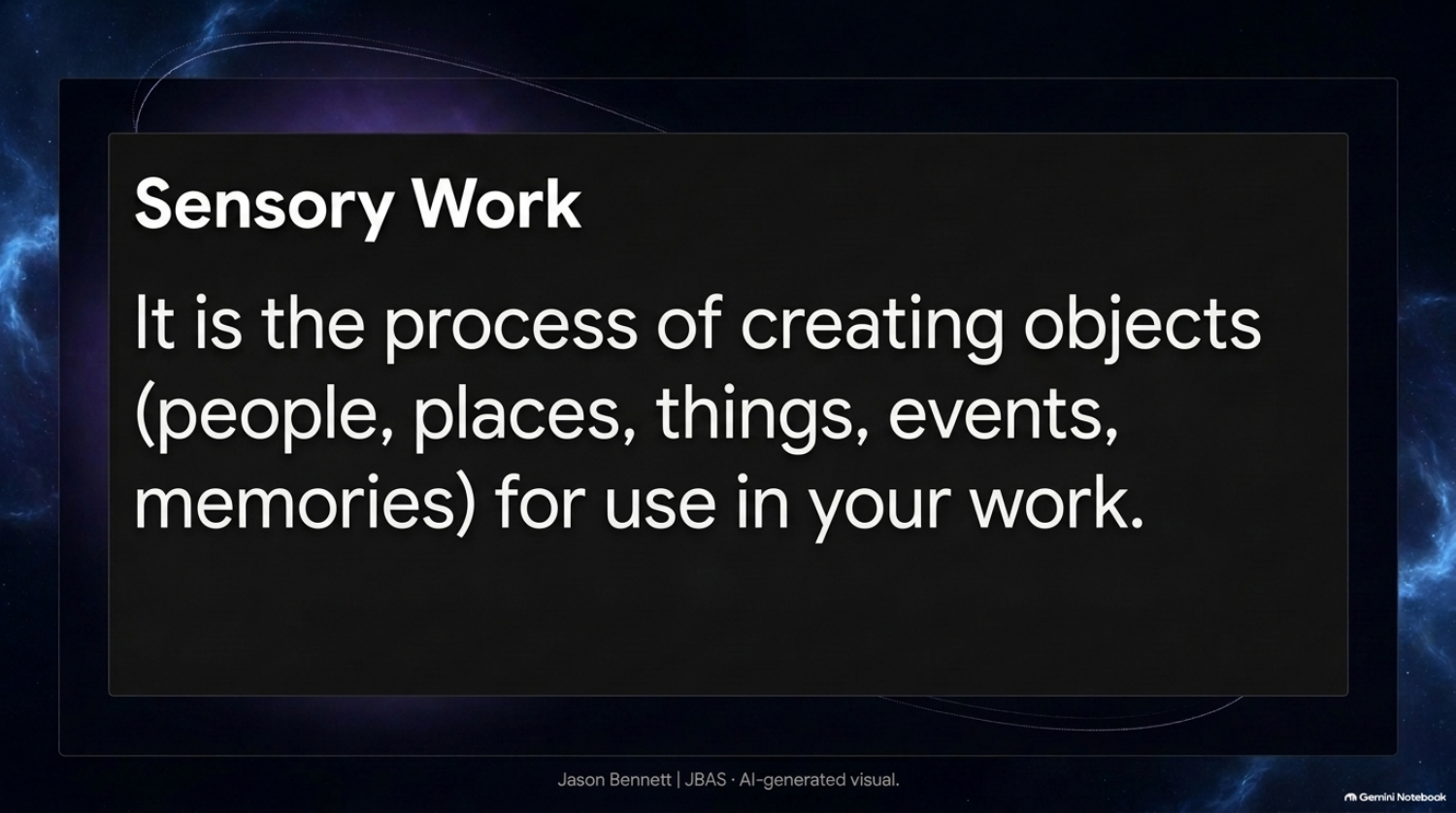
It is the process of creating objects (people, places, things, events, memories) for use in your work.
Jason Bennett | JBAS
What is Sensory Work?
You investigate what something looks, sounds, smells, tastes or feels like. You can begin with an object in front of you, recall something from your life, or create something imaginary. Sensory questions give your attention something specific to work on. You answer through sensory experience as well as through ideas about the scene.
It is the process of creating objects (people, places, things, events, memories) for use in your work.
Jason Bennett, from the original The Principles That Guide Our Actor Training.
You meet this process alongside Imaging. Imaging gives you mental images; sensory work lets you investigate their particular qualities. When you re-create something from your own experience, the work is often called sense memory. You can also work with invented places and events. Your imagination has more than remembered experience to draw on.
What happens in the room?
You may begin with the cup exercise in Jason Bennett's class handout. You hold a cup of liquid and attend to its sensory details. Then you put it out of sight and work with the imagined cup, asking the same sensory questions. You return to the actual object, notice more, and try again. Jason Bennett can help you understand what it means to answer with your senses.
You can extend the investigation from an object to a place. In Tour of Two Places, you create imagined surroundings and events with sensory detail, then give the class a tour. You work on where things are, the atmosphere of the place and the experiences connected to it. The exercise gives you a world to inhabit and a story to tell.
A fundamental requirement of an actor is the ability to truthfully create and respond to imaginary objects and events.
Jason Bennett, from Exercises for Classes, “Creating an Object.”
You then test the work with a scene or monologue and in relationship with another actor. Notice whether the place, object or relationship becomes more specific, and whether you can keep receiving your partner. You can adjust what you use. The preparation needs to serve the writing and what happens between you.
You can pause or decline an exploration. You do not have to disclose private experiences to prove your seriousness. This is actor training, not psychotherapy or medical treatment.
Who is this work for?
You can work on the basics of creating an imaginary object or bring a scene that asks for a more particular world. You may be building an acting process, or revisiting a familiar tool after years of training. Your work begins with what you need and the material you want to perform.
You might need a specific place for a monologue, an absent person to speak to, or a more vivid relationship to an object in a scene. You can investigate those needs through this process and compare it with other tools in your rehearsal.
Begin with a conversation
Study Sensory Work with Jason Bennett. Begin with a brief phone conversation.
Read further
Sensory Work in the Encyclopedia of Acting gives you the definition and a rehearsal example.
The Curious Imagination takes you further into sensory detail, invented worlds and bringing imaginative discoveries into your material.